Introduction
Every week, facilities managers at schools, sports complexes, parks departments, and HOAs face the same operational grind: natural grass demands constant labor, burns through water budgets, and still closes fields after rain. Maintenance crews spend hours mowing, fertilizing, and reseeding. Irrigation systems run daily during the growing season, consuming thousands of gallons and driving up utility bills. Despite all that effort, fields still go dark after storms — forcing cancellations and sending revenue elsewhere.
The conversation about synthetic turf has moved beyond aesthetics. What matters now is weekly operational reality: fewer staff hours, lower utility bills, and fields that stay open regardless of weather.
According to the City of Palo Alto's 2025 comparative analysis, natural grass fields require approximately $42,000 in annual maintenance versus just $6,000 for synthetic turf — a 7:1 cost advantage that shows up in every budget cycle.
This article breaks down the measurable advantages of synthetic turf across three areas: labor hours, water consumption, and maintenance spending. If you're weighing a turf proposal right now, the figures below give you a clear picture of what to expect — and when the investment starts paying for itself.
Key Takeaways
- Synthetic turf eliminates irrigation entirely, saving 1.9–2.7 million gallons per field annually
- Maintenance costs drop from ~$42,000/year to ~$6,000/year by eliminating mowing, fertilizing, and reseeding
- Playable 4,300+ hours/year versus 400–600 hours for natural grass
- Cost per hour of use: $79 for synthetic versus $184 for natural grass over 20 years
- One synthetic field handles the load of 3–4 natural grass fields
What Is Synthetic Turf?
Synthetic turf is an engineered surface made from synthetic fibers designed to replicate the performance and appearance of natural grass, installed over a layered base system that provides drainage, stability, and cushioning. It's used where consistent surface performance and reduced upkeep are priorities: athletic fields, school playgrounds, community parks, HOA common areas, sports complexes, and commercial outdoor spaces.
What makes it worth the investment is operational: it removes the inputs—water, labor, chemicals, equipment—required to keep a playing surface safe and usable year-round. The Synthetic Turf Council describes it as a surface that "provides a consistent year-round, all-weather playing surface built for extended use without requiring downtime for recovery."
Standard system components include:
- Aggregate base/drainage system – Compacted stone providing stability and facilitating water runoff
- Shock pad – Elastic layer (typically 19mm, 25mm, or 35mm) designed for safety and impact attenuation
- Infill – Materials placed between fibers (crumb rubber, EPDM, silica sand, or organic options like cork)
- Fiber (pile) – Polypropylene, polyethylene, or nylon in tape or monofilament form
- Backing – Primary woven/non-woven fabric plus secondary coating for tuft bind and structural integrity
Quality turf systems should meet CPSIA certification standards, with lead levels far below 100 ppm and full phthalate compliance—important benchmarks for any school, park, or athletic facility procurement.
Key Advantages of Synthetic Turf
The three advantages below are operational and measurable. Each one impacts a budget line, a staff schedule, or a facility's available hours—making them directly relevant to anyone managing outdoor spaces.
Water Conservation: Eliminating Irrigation Entirely
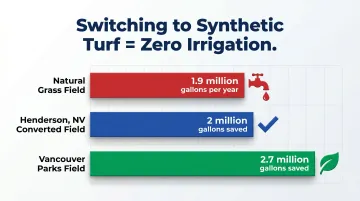
Natural grass fields require regular irrigation to survive. A standard grass field consumes approximately 50,000 gallons of water per week during the growing season. The Palo Alto study documents that an 80,000 sq ft turfgrass field in the Bay Area requires approximately 1.9 million gallons annually.
Once you switch to synthetic, that number drops to zero. The surface stays green and functional without any water input, and built-in drainage systems handle rain without damage or field closures.
Real-world impact:
- The Southern Nevada Water Authority documented 2 million gallons of water saved for each grass field converted to synthetic turf in Henderson, NV
- Vancouver Parks reported savings of up to 2.7 million gallons per field annually
- In drought-prone regions or municipalities under water restrictions, eliminating irrigation removes compliance risk and potential fines
KPIs impacted:
- Annual water utility costs
- Irrigation system maintenance expenses
- Regulatory compliance burden related to outdoor water use
Best fit for:
Facilities in dry or drought-affected climates, organizations managing multiple fields, and municipalities under water conservation mandates. Nevada's AB 356 mandates removal of all non-functional turf by January 1, 2027, and Southern Nevada prohibits new irrigated grass in commercial developments.
Athletic fields are generally exempt from these mandates, but the regulatory trend makes synthetic turf a forward-looking choice for any facility planning long-term.
Reduced Maintenance: Getting Back Staff Hours and Eliminating Equipment Costs
Maintaining natural grass is a recurring labor cycle: mowing, fertilizing, aerating, overseeding, pest and weed control. These tasks require dedicated staff, specialized equipment, and continuous chemical purchases.
Installation ends that cycle. The surface requires only occasional grooming—brushing fibers upright, clearing debris—and periodic inspection. Mowing equipment, fertilizer programs, and pesticide applications all come off the budget.
Real-world impact:
- Palo Alto's analysis found annual maintenance costs of approximately $42,000 for native soil natural grass versus $6,000 for synthetic turf per field
- Woodland Schools reported similar findings: $52,500 for natural grass versus $5,000 for synthetic turf
- Removing chemical treatments eliminates procurement, storage, and disposal costs—and reduces liability and environmental impact for schools and public parks
- For facilities managing multiple fields, the maintenance reduction multiplies: a school or sports complex with several fields can eliminate significant annual labor and supply costs
Natural grass tasks eliminated:
- Mowing (weekly during growing season)
- Aerating (2x/year standard; 4-6x/year for high-use fields)
- Fertilizing (multiple applications annually)
- Overseeding and renovation (4-6 weeks downtime)
- Pesticide/herbicide application
- Irrigation system repairs and adjustments
What gets measured:
- Grounds staff labor hours
- Annual maintenance supply budget
- Equipment depreciation and replacement costs
- Chemical procurement costs
Best fit for:
Most impactful for schools and sports complexes managing multiple fields with limited grounds staff. Also significant for HOAs and parks departments where maintenance is contracted out at hourly rates.
Year-Round Playability: Treating Field Downtime as a Cost
Natural grass fields require recovery time after heavy rain, intense use, or seasonal dormancy. Games get cancelled, practices are relocated, and field rental revenue is lost. This downtime is a real operational and financial cost that rarely appears in maintenance budget comparisons.
Engineered drainage systems remove standing water quickly, the surface doesn't develop bare patches from overuse, and there is no dormancy period. The field is simply available more often.
Capacity comparison:
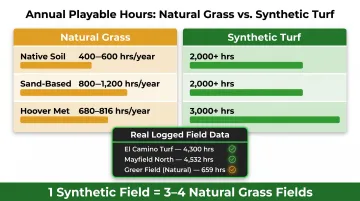
| Source | Natural Grass Annual Hours | Synthetic Turf Annual Hours |
|---|---|---|
| Palo Alto (native soil) | 400-600 hours/year | 2,000+ hours/year |
| Palo Alto (sand-based) | 800-1,200 hours/year | 2,000+ hours/year |
| Hoover Met Complex | 680-816 hours/year | 3,000+ hours/year |
Actual logged usage from Palo Alto municipal fields:
- El Camino Turf (synthetic): 4,300 hours/year
- Mayfield North (synthetic): 4,532 hours/year
- Greer Field 1 (natural grass): 659 hours/year
The Palo Alto study confirms that one synthetic field has the carrying capacity of 3 to 4 native soil natural grass fields.
Weather-related advantage:
Natural grass requires 24-72 hours of downtime after rain events; synthetic turf requires 0-12 hours. Natural fields are often closed December through March for weather-related reasons and require 10-12 weeks annually for rest and renovation.
Real-world impact:
- For schools and athletic programs, more available field hours means more scheduling flexibility, fewer program conflicts, and the ability to host more events or revenue-generating rentals
- Parks and recreation facilities remain open after rain or during dry seasons, serving communities without weather-dependent closures
- Over 20 years, synthetic turf costs approximately $79 per hour of use versus $184 per hour for native soil grass
What gets measured:
- Annual field hours utilized
- Event cancellation rate
- Field rental revenue
- Community programming capacity
Best fit for:
Facilities in regions with frequent rain or drought extremes get the clearest benefit, along with schools juggling multi-sport programs competing for field time. Sports complexes where field rental income offsets operating costs also see strong returns.
What Happens When Facilities Stick with Natural Grass
As wear increases on high-traffic natural grass fields, maintenance costs rise, field closures become more frequent, and the cost to restore or reseed grows. This creates a cycle where the field becomes less usable as it becomes more expensive.
The Sports Field Management Association notes that "the primary reason natural grass fields are being replaced by synthetic is usually due to the lack of initial maintenance dollars." When maintenance is deferred, fields deteriorate rapidly.
Hidden costs that rarely appear in initial comparisons:
- Staff overtime during peak maintenance seasons
- Emergency reseeding after major events
- Irrigation system repairs and component replacement
- Cost of cancelled programming and lost rental revenue
The scale of deferred maintenance is visible in districts across the country. LAUSD currently has 7 deteriorated high school athletic fields requiring immediate replacement, affecting approximately 10,000 students.
Financial costs are only part of the problem. Scheduling limitations compound the pressure on administrators and athletic directors.
Seasonal availability:
Natural grass fields are typically closed 10-12 weeks annually for rest and renovation — and rest periods run 4-6 weeks minimum before the surface can handle play again. Many fields sit unused from December through March, not because of programming gaps, but because the grass simply can't recover fast enough.
For schools managing several athletic surfaces, or parks departments overseeing entire sports complexes, these closures stack up quickly. Every week a field is offline represents lost practice time, cancelled rentals, and programming that has to move elsewhere — or get cut entirely.
How to Get the Most Value from Synthetic Turf
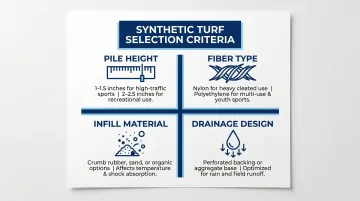
Synthetic turf delivers its full cost and operational advantages only when the right product is selected for the application. Pile height, fiber type, infill material, and drainage design should all align with the specific use case — a multi-sport field has very different demands than a playground, a batting cage, or a landscaped common area.
Matching specs to the use case prevents early wear, drainage problems, and unnecessary replacement costs. Key selection factors to evaluate include:
- Pile height: Shorter piles (1–1.5") work well for high-traffic sports fields; taller piles (2–2.5") suit recreational and aesthetic applications
- Fiber type: Nylon holds up under heavy cleated use; polyethylene offers a softer feel for multi-use and youth sports surfaces
- Infill material: Crumb rubber, sand, or organic infill options each affect surface temperature, shock absorption, and maintenance requirements
- Drainage design: Perforated backing or aggregate base layers are essential for fields that collect rainwater or experience irrigation runoff
Beyond product specs, installation quality determines how long those specs actually perform. Poor seam work, inadequate base compaction, or skipped drainage layers can shorten turf life by years — erasing the savings that made synthetic turf appealing in the first place.
Facilities that get the most from synthetic turf treat it as a system, not just a surface. That means pairing the right turf product with proper base preparation, professional installation, and a simple maintenance routine: occasional brushing to keep fibers upright, rinsing to clear debris, and periodic infill top-offs as needed. With those basics in place, synthetic turf consistently delivers on its promise of lower costs, fewer maintenance hours, and a field that stays usable year-round.