While most buyers spend hours researching turf products — comparing pile heights, face weights, and fiber types — far fewer know how to properly vet the company doing the installation. Here's the reality: even premium turf will underperform if installed without proper drainage, base preparation, or certified shock padding. The company you choose determines whether your investment delivers 10+ years of safe, durable performance or becomes a costly liability within the first season.
This guide closes that gap. You'll learn exactly which credentials to verify, which questions expose unqualified installers, and which red flags signal you should walk away — whether you're planning a backyard play area, a school playground, or a full athletic complex.
Key Takeaways
- Bad installation voids warranties and cuts field lifespan in half, regardless of turf quality
- Confirm STC installer certification, ASTM F1292/IPEMA/CPSIA product certifications, and a portfolio of comparable completed projects
- Get itemized quotes breaking out materials, base prep, drainage, shock pad, and labor — playground installs typically run $9–$14/sqft
- Walk away from any installer who can't name their products, skips base prep in the quote, or won't provide a written warranty
- A qualified installer guides you through product selection, explains their process clearly, and stays accountable after the job is done
What Does an Artificial Turf Installation Company Actually Do?
Professional turf installation is not a single task — it's a coordinated system where every component must work together. According to research published in Sports Health, a modern synthetic turf system consists of: compacted gravel or engineered base, an optional shock-absorbing pad (up to 25 mm thick), turf carpet with fibers tufted into a backing layer, and granular infill (25-40 mm deep) of materials such as silica sand or organic alternatives like coconut fiber.
The Installation Process Breakdown
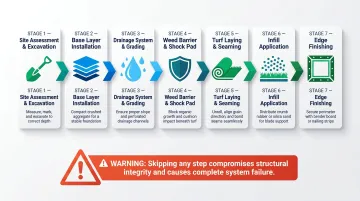
Each step in the installation sequence serves a specific function, and skipping any one of them creates problems:
Site Assessment & Excavation The installer evaluates existing surface conditions, drainage patterns, and grading requirements, then excavates to the proper depth to accommodate the base system.
Base Layer Installation A 4-6 inch compacted aggregate base provides structural support and drainage. Poor base preparation is the leading cause of premature turf failure.
Drainage System & Grading Proper slope grading (typically 1-2% grade) ensures water doesn't pool on the surface. The CPSC Public Playground Safety Handbook notes that surfacing materials must meet ASTM F1292 impact attenuation requirements — which means all system components (base, pad, turf, infill) must work together to achieve the rated critical fall height.
Weed Barrier & Shock Pad A permeable weed barrier prevents vegetation growth while allowing drainage. For playgrounds and athletic applications, a shock-absorbing pad rated to specific critical fall heights is mandatory for safety compliance.
Turf Laying & Seaming Carpet sections are joined using specialized adhesives and seam tape. According to documented lawsuits tracked by SynTurf.org, seam failures have resulted in serious injuries — including one South Dakota case where a player caught his foot in a turf "fold or flap," tearing all knee ligaments, resulting in a $500,000 award.
Infill Application & Edge Finishing Infill materials stabilize the turf and provide cushioning. Edge securing methods prevent lifting and create clean borders.
Why Installation Quality Matters More Than Product Choice
The Synthetic Turf Council (STC) publishes technical guidelines described as "a comprehensive guide designed to focus on non-regional synthetic turf installation methods to achieve optimal appearance and performance." These guidelines treat turf, shock pad, drainage base, and infill as a single integrated system — every component depends on the others performing correctly.
A poorly installed system can fail ASTM testing even if every individual material carries certification. That's why installer experience matters as much as product specs — and why the right evaluation criteria depend on your specific project type.
Installation companies serve a wide range of applications, each with distinct requirements:
- Residential backyards and HOA common spaces
- Playground areas requiring ASTM F1292 impact attenuation compliance
- School campuses and multi-use recreational fields
- Athletic fields and collegiate sports complexes under heavy concentrated traffic
A company with strong residential experience isn't automatically qualified for a safety-rated playground or a collegiate field. The project type should drive your vetting process from the start.
Key Factors to Evaluate When Hiring an Artificial Turf Installation Company
Price matters, but it shouldn't be your primary decision driver. The factors below connect directly to real-world outcomes: safety compliance, durability, and long-term cost. Evaluate installers systematically across these criteria to avoid costly mistakes.
Experience and Portfolio Depth
Verify how many years the company has operated and whether they've completed projects at your scale and use-type. A company with residential lawn experience may lack the expertise for a 5,000 sqft school playground requiring ASTM-rated shock pads and certified materials.
What to request:
- Portfolio with before-and-after photos showing project scale and scope
- Specific details: square footage, use case (playground, athletic field, training facility), and completion date
- Three client references you can contact directly — and actually call them
Look for diversity in project types. An installer with experience across playgrounds, athletic fields, and training facilities understands different drainage needs, base requirements, and performance standards. According to The Motz Group's guidance, even straightforward athletic field replacements require "a whole season" for completion when you account for planning, bidding, permitting, site prep, and installation — and experienced companies will tell you that upfront.
Installer certification matters: The STC Certified Synthetic Turf Installer (CSTI) credential was developed specifically for landscape and recreation turf systems. It requires passing a formal exam and renewing every two years, signifying comprehensive knowledge in installing synthetic turf for these applications.
Certifications and Safety Compliance
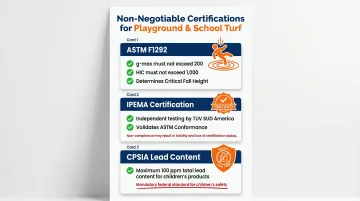
For playgrounds, schools, and athletic facilities, product certifications are non-negotiable. Confirm the company works with turf products meeting these standards:
ASTM F1292 (Impact Attenuation)
This standard establishes minimum performance requirements for playground surfacing within equipment use zones. ASTM F1292-22 measures g-max (maximum acceleration, must not exceed 200) and HIC (Head Injury Criterion, must not exceed 1,000) to determine critical fall height — the maximum height from which a surface can be fallen upon while staying within safe limits.
IPEMA Certification
IPEMA provides third-party product certification validating conformance to ASTM standards through independent testing by TUV SUD America. This certification verifies claims rather than relying on manufacturer self-reporting.
CPSIA Lead Content Compliance
Federal law (15 U.S.C. 1278a) requires that accessible components of children's products contain no more than 100 ppm total lead content. For playground and school applications, verify the installer can provide documentation that their turf and infill materials meet this standard.
A reputable installer will provide certification documentation without hesitation. For playground and school environments, ASTM-compliant shock pads with critical fall heights matched to equipment height are mandatory — treat missing paperwork as a disqualifying factor, not a minor gap.
Material Quality and Sourcing Transparency
Vague answers like "we use quality turf" signal trouble. The installer should clearly identify:
- Turf brand and manufacturer
- Fiber material (polyethylene, polypropylene, or nylon)
- Pile height (typically 20-40 mm for general use, 40-70 mm for sports fields)
- Face weight (measured in ounces per square yard)
- Infill type and composition
Why face weight and fiber density matter:
According to industry specifications, face weight measures the weight of yarn fiber per square yard. Higher face weight (generally over 80 oz/sqyd) produces thicker, more durable turf that resists matting in high-traffic areas like playgrounds and sports fields.
Fiber material comparison:
| Material | Best Use | Durability | Cost |
|---|---|---|---|
| Polyethylene (PE) | Sports fields, playgrounds | High (soft, natural feel) | Standard |
| Polypropylene (PP) | Decorative, low-traffic | Low (prone to matting) | Lowest |
| Nylon | High-traffic, premium fields | Highest (98% elastic recovery) | +20% premium |
A knowledgeable installer will walk you through these tradeoffs — explaining why polyethylene suits a playground over nylon, or why polypropylene fails under heavy foot traffic — rather than defaulting to the highest-margin product.
Installation Process and Methodology
Ask the installer to walk you through their process step-by-step. Specifically confirm:
Sub-base preparation: Industry standard calls for 4-6 inches of crushed stone aggregate, compacted and graded. Shortcuts here cause the most common failures.
Drainage system: Proper slope grading (1-2% grade) prevents water pooling. The weed barrier must be strong enough to suppress weeds yet porous enough to allow drainage — backing should achieve 500-1,000 liters/hour/m² drainage rates.
Shock pad layer: For playgrounds and athletic fields, verify the installer includes a shock pad rated to appropriate critical fall heights. This component is essential for ASTM F1292 compliance.
Seam technique: Improperly joined seams create tripping hazards and visible failures within the first year. A professional installer will specify adhesive types, seam tape products, and border anchoring methods rather than giving generic answers. Remember the South Dakota lawsuit: poor seaming resulted in catastrophic injury and a half-million-dollar judgment.
Warranty Coverage and Post-Installation Support
Distinguish between two separate warranties:
Manufacturer's material warranty: Typically 8-15 years depending on brand. Warranty duration varies significantly — premium brands offer up to 15 years for landscape turf, while entry-level products may provide only 5 years.
Installer's workmanship warranty: Covers installation-related defects such as seam failures, drainage issues, or improper base preparation. Get both warranties in writing before you sign.
Clarify what voids the warranty. Common exclusions include improper maintenance, unauthorized infills or chemicals, burns, vandalism, and failure to report issues promptly. Understand who is responsible for honoring each warranty — the manufacturer or the installer.
Ask whether the company offers post-installation support:
- Maintenance guidance and best practices
- Return visits for infill top-ups
- Seam inspections and adjustments
- Brushing schedules to prevent matting
Post-installation support reduces your total cost of ownership — a company that returns for annual infill top-ups and seam checks will extend the turf's functional life by years compared to one that hands over a manual and disappears.
Transparent Pricing and Itemized Quotes
Request a fully itemized written quote separating:
- Turf material cost ($/sqft)
- Base preparation labor
- Drainage components
- Shock pad (if required)
- Infill materials
- Installation labor
- Edge finishing and borders
Industry cost benchmarks:
| Application | Typical Range (Installed) |
|---|---|
| Playground (school/park) | $9-$14/sqft |
| Athletic field (football) | $5-$12/sqft |
| Residential/HOA | $7-$19/sqft |
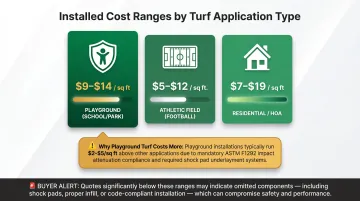
According to Texas Tuff's playground cost guide, playground turf runs $2-$5 more per sqft than standard lawn turf due to ASTM F1292 fall-height ratings, impact attenuation testing, and shock pad requirements.
Be cautious of quotes significantly below market rate with no explanation. This typically signals omitted components — most commonly base prep, shock pad, or certified materials — to lower the headline price while compromising system performance.
Red Flags to Watch Out For
These warning signs point to installers worth avoiding:
No line-item quotes or written warranties. Any company that provides only a lump-sum number and can't name the specific turf product or its certifications will operate the same way once the project starts. Get itemized proposals and warranty documentation before signing anything.
Pressure tactics. "This price is only valid today" or a reluctance to share references from comparable projects. Walk away.
Proposals missing critical components. Watch for bids that omit site preparation, drainage grading, or shock pad installation — particularly for playgrounds and schools, where ASTM fall-height compliance depends on the complete system. Over 60% of California playgrounds fail safety inspections due to ASTM standard violations, often because installers cut corners on these steps.
A pattern of real-world failures. Skipped components don't just fail inspections — they cause injuries. Two documented cases illustrate the stakes:
- A Staten Island student fell on wet turf described as "extremely slippery" due to inadequate drainage design, resulting in a lawsuit.
- 44 students at Euclid Elementary in San Diego were sent to the nurse for heat exhaustion on the first day their crumb rubber field opened.
Questions to Ask Before You Sign a Contract
Use these questions to evaluate every installer:
Product & Certification Questions:
- What turf product do you recommend for my use case and why?
- What safety certifications does that product carry (ASTM F1292, IPEMA, CPSIA)?
- What is the face weight, pile height, and fiber material of the recommended turf?
Installation Process Questions: 4. Walk me through your base preparation process step-by-step 5. How do you handle drainage and what slope grading do you use? 6. What seaming technique and adhesive products do you use?
Warranty & Reference Questions: 7. What does your workmanship warranty cover and for how long? 8. Can you provide three references from similar projects I can contact? 9. How do I maintain the turf after installation, and what voids the warranty?
How an installer answers matters as much as what they say. A knowledgeable contractor gives specific, confident responses without deflecting — if they hedge on base preparation or can't name the adhesive products they use, that's a red flag worth taking seriously.
Get at least three quotes using these same questions. Consistent questions across every bidder let you compare installers on equal footing — and give schools, parks departments, and HOAs the documented basis they need to justify their vendor selection.
How The Windscreen Factory Can Help
The Windscreen Factory has served schools, universities, sports complexes, HOAs, parks and recreation departments, and private businesses since 2014. That track record means the team understands the practical pressures facility managers and project leads face when planning turf installations and surrounding infrastructure.
For organizations planning turf as part of a broader facility upgrade, The Windscreen Factory supplies and installs complementary sports facility components, including:
- Custom netting — 100% twisted knotted nylon with UV protection
- Wall and post padding with custom logo printing
- Branded windscreens and fence screens
- Shade structures for dugouts, benches, and playgrounds
- Field graphics and facility signage
Working with a single provider for these components eliminates the cost and complexity of coordinating multiple specialty vendors.
The Windscreen Factory's products meet CPSIA certification standards with lead levels far below 100 ppm and comply with all phthalate requirements — a meaningful distinction for schools, parks, and family-oriented facilities with strict material safety requirements.
The Windscreen Factory's in-house design capabilities and installation teams serve customers throughout the United States, with experience spanning batting cages and training facilities to full athletic complexes.
Contact The Windscreen Factory at 888.619.2228 or sales@thewindscreenfactory.com to discuss integrated turf and facility solutions tailored to your project requirements.
Conclusion
The installation company you choose determines the long-term performance, safety, and ROI of your turf investment — more than the turf brand, the pile height, or the infill type. Even premium turf will underperform if installed without proper base prep, drainage, or certified shock padding.
The evaluation criteria in this guide apply whether you're installing a backyard play area, a school playground, or a full athletic complex:
- Experience with your specific project type and scale
- Certifications relevant to safety and installation standards
- Material transparency on turf specs, infill, and base components
- Installation methodology including base prep and drainage approach
- Warranty coverage that's written, clear, and enforceable
- Pricing clarity with no vague line items or hidden allowances
These standards separate qualified professionals from installers who cut corners.
The right partner should make the process straightforward: clear answers, written documentation, proven references, and a track record that holds up long after installation day. If a company can't deliver those basics upfront, that tells you everything you need to know before signing anything.
Frequently Asked Questions
How much does artificial turf cost for a playground?
Playground turf typically runs $6–$20/sqft installed, with most school and park projects landing at $9–$14/sqft. A 500 sqft play area generally costs $5,000–$8,000; a 5,000 sqft school playground commonly runs $35,000–$75,000. Final cost depends on shock pad requirements, site prep needs, and infill type.
Which artificial grass is best for a playground?
Prioritize high face weight (42–60 oz/sqyd for safety-grade), dense polyethylene fibers resistant to matting, and a shock pad with an ASTM-rated critical fall height matched to your equipment. Safety compliance depends on the complete system, not the turf fiber alone.
What certifications should an artificial turf installation company have?
Look for ASTM F1292 compliance for impact attenuation, IPEMA third-party certification for playground applications, and CPSIA material safety standards confirming lead content below 100 ppm. The installer should hold an STC Certified Synthetic Turf Installer (CSTI) credential and provide written documentation for all product certifications.
How long does artificial turf installation typically take?
Project timelines vary based on site size, existing surface conditions, and whether base excavation is required. Turf installation itself takes 3-6 weeks for athletic fields and 3-5 days for smaller projects, but total project duration including planning, permitting, and site prep can extend 12-24 months for large facilities.
What questions should I ask before hiring an artificial turf installation company?
Ask about product certifications (ASTM F1292, IPEMA, CPSIA), base prep process, workmanship warranty terms, and verifiable references from similar projects. Strong answers should be specific and provided in writing — vague responses are a warning sign.
Does artificial turf installation come with a warranty?
Professional installations should include two separate warranties: the manufacturer's product warranty (typically 8-15 years covering material defects and UV stability) and the installer's workmanship warranty (covering installation-related defects like seam failures or drainage issues). Request both in writing before signing any contract.