
Introduction
Heat-related illness sends thousands of athletes to emergency rooms each year — and outdoor sports facilities without adequate shade are at the center of that problem. For facility managers, school administrators, and parks departments, shade structures have shifted from a budget line item to a core safety investment.
The case for shade is well known. What gets skipped over is the practical, day-to-day impact: how overhead coverage affects player safety, scheduling capacity, operating costs, and long-term facility value.
This article breaks down those measurable benefits specifically for outdoor sports environments — giving decision-makers a clear picture of what engineered shade coverage actually delivers.
Key Takeaways
- Shade structures block up to 97% of harmful UV rays and reduce surface temperatures by up to 34°F, lowering heat illness risk
- More usable daytime hours mean longer visits, more event bookings, and higher revenue potential
- Unprotected facilities face accelerated equipment degradation, with synthetic turf fields costing $350,000-$650,000 to replace
- Properly specified HDPE shade structures deliver 10-12 year service lives, offsetting upfront costs through deferred equipment replacement
- Custom-branded shade doubles as facility identity and sponsorship assets
What Are Shade Structures for Outdoor Sports Facilities?
Shade structures for sports facilities are engineered overhead coverings—including tensile sails, cantilever canopies, hip-roof structures, and bleacher covers—designed to block solar radiation over courts, fields, dugouts, sidelines, and spectator areas.
These structures are typically installed across:
- Bleachers and grandstands
- Dugouts and team benches
- Tennis and basketball courts
- Baseball fields and multi-use athletic pads
- Spectator sideline areas and event venues
Shade structures are an operational infrastructure decision. They directly affect how long a facility can be safely used, how often it gets booked, and how long its surface materials last.
The Windscreen Factory supplies custom shade solutions for dugouts, bleachers, pool decks, concession areas, and viewing zones — part of a broader catalog that includes windscreens, netting, and branded padding for sports facilities nationwide.
Key Benefits of Shade Structures for Outdoor Sports Facilities
The benefits below are measurable outcomes that facility managers, school administrators, and parks departments can track through safety metrics, cost performance, and facility utilization data. Well-specified shade structures deliver increasing returns over time as they protect both people and assets across years of use.
Player & Spectator Safety: UV Protection and Heat Illness Prevention
Exertional heat stroke (EHS) is one of the leading causes of on-field sudden death among athletes. Approximately 9,237 high school athletes suffer heat-related illness annually in the United States, with football accounting for 70.7% of cases at a rate 10 times higher than other sports. From 1982 through 2022, 67 exertional heat stroke deaths occurred in secondary school sports, with 75% in the Southern U.S. This makes shade a frontline preventive measure, not merely a comfort feature.
How shade structures physically reduce risk:
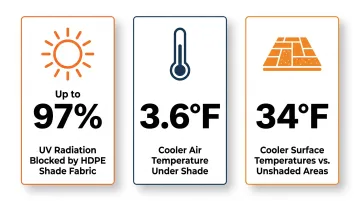
Commercial-grade HDPE (high-density polyethylene) shade fabric blocks up to 97% of UV radiation and provides up to 95% shade factor. Research shows shade reduces air temperature by up to 3.6°F and surface temperatures by up to 34°F compared to unshaded surfaces—measurably lowering heat stress on players and seated spectators.
The liability case:
Reduced heat-related incidents lower liability exposure for facility operators, decrease athlete downtime from heat illness, and allow events to proceed safely during peak summer temperatures. Documented settlements include a $39.5 million college heat stroke case and a $9 million wrongful death award for a youth soccer player. A single incident, in other words, can cost more than the entire shade infrastructure investment.
KPIs impacted:
- Heat-related incident rate
- Medical stoppage frequency
- Event cancellations due to heat
- Athlete performance consistency during summer seasons
When this matters most:
High-heat months in southern and mid-Atlantic states, facilities serving youth athletes or older spectators, and venues hosting multi-hour tournaments or double-header events.
Extended Facility Usability and Revenue Potential
Unshaded facilities effectively limit their usable window to cooler morning or late-afternoon hours. Shaded facilities can comfortably operate throughout the day—significantly expanding scheduling capacity and event-hosting ability.
The operational change:
Shade structures allow facility managers to book more tournaments, community leagues, school events, and fitness classes during peak daytime hours that would otherwise be unusable due to heat. Research on public playgrounds found a statistically significant positive correlation between shade coverage and total visitors (rs = 0.259, p = 0.017), with 49% of unshaded playgrounds having zero users during peak sun hours.
Revenue and community impact:
Expanded usable hours translate directly to higher booking revenue, more competitive grant eligibility for community recreation facilities, and greater community engagement. Spectators who stay cool under shade remain for the full event—increasing concession revenue and program participation. Local park and recreation agencies generated more than $201 billion in economic activity in 2021. For parks departments under budget pressure, maximizing field utilization is one of the most direct levers available.
KPIs impacted:
- Daily event bookings
- Facility utilization rate (hours/day)
- Spectator dwell time
- Seasonal revenue from field rentals
- Program enrollment
When this matters most:
Facilities in sun-heavy climates, parks and recreation departments trying to maximize ROI on field infrastructure, and sports complexes competing for regional or national tournament hosting rights.
Protecting Your Facility Investment: Equipment and Surface Longevity
UV radiation and sustained heat exposure accelerate the degradation of nearly every surface and piece of equipment in outdoor sports facilities—bleacher seating, court surfaces, fencing, padding, and netting included.
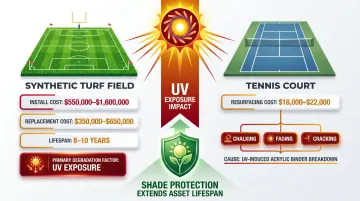
The replacement costs are substantial. Synthetic turf soccer fields cost $550,000–$1,600,000 to install and $350,000–$650,000 to replace, with UV exposure ranking among the primary degradation factors affecting their 8–10 year lifespan. Tennis court resurfacing runs $18,000–$22,000, with UV radiation causing acrylic binder breakdown that manifests as chalking, fading, and cracking.
How shade structures slow degradation:
By blocking direct sunlight from reaching equipment and surfaces, shade prevents UV-induced fading, polymer degradation, cracking, and warping—extending the effective service life of facility assets. The Windscreen Factory's shade structures use commercial-grade HDPE material that blocks up to 95.5% of UV radiation, and the fabric is heat treated and mildew resistant—built specifically to hold up in the outdoor sports environments where these assets need to last.
Budget impact:
Deferred replacement costs and lower maintenance frequency represent significant budget savings for municipalities, schools, and private operators. Even a modest extension of synthetic turf lifespan from 8 to 10 years can defer hundreds of thousands of dollars in capital expenditure.
KPIs impacted:
- Average replacement cycle for surfaces and equipment
- Annual maintenance spend
- Capital expenditure frequency
- Total cost of ownership for outdoor facility assets
What Happens When Shade Structures Are Missing or Ignored
Operating without shade creates compounding costs across every aspect of facility management:
- Heat illness incidents create liability exposure and potential legal costs
- Canceled or shortened events directly reduce revenue
- Athletes migrate to competing facilities that offer shaded amenities
- Unprotected equipment degrades faster, increasing capital replacement frequency
Youth athletic programs, school teams, and community leagues prioritize comfort and safety when choosing where to practice and compete. Facilities without shade signal inadequate investment in user wellbeing.
Research shows that each additional month with average temperature above 82°F increases physical inactivity by 1.5 percentage points, projected to cause 500,000 additional premature deaths annually by 2050. Facilities without shade lose participation during precisely the months when outdoor activity is most needed.
The reactive pattern that emerges is consistently more expensive: facilities spend on treating consequences (medical support, early event termination, emergency equipment repairs) rather than preventing them. With U.S. heat waves now averaging 6 per year (triple the 1960s rate) and the heat wave season 46 days longer, the cost of inaction consistently exceeds the cost of a well-chosen shade solution.
How to Get the Most Value from Shade Structures
Shade structures deliver maximum value when matched to the sport and coverage area. Bleacher canopies for spectator zones, large-span cantilevers for full court coverage, and dugout covers for player areas all serve distinct functions—applying a one-size-fits-all product sacrifices performance and cost efficiency.
Shade structures perform best as part of a deliberate facility plan. Paired with windscreens, safety netting, and proper orientation to the sun's path, they form a coordinated environmental control system rather than a patchwork of disconnected products.
The Windscreen Factory provides custom-designed shade solutions alongside windscreens, netting, and branded padding. Single-source project coordination simplifies procurement and keeps facility aesthetics consistent.
Treat shade as an ongoing infrastructure asset:
- Schedule periodic inspection to ensure fabric tension and hardware remain intact
- Clean HDPE fabric with mild, pH-neutral detergent and water to maintain performance
- Upgrade coverage as the facility expands or usage increases
- Replace components proactively rather than waiting for failure
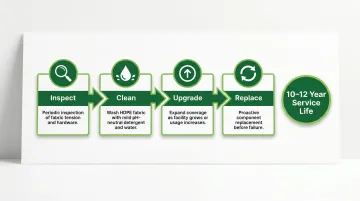
With proper maintenance, commercial-grade HDPE shade structures deliver service lives of 10-12 years with manufacturer warranties covering material integrity—a reliable return on a capital investment most facilities won't revisit for over a decade.
Conclusion
The value of shade structures for outdoor sports facilities is measurable and operational. They protect athletes and spectators from preventable heat illness, unlock more usable hours and revenue potential, and extend the physical lifespan of the facility's most expensive components. These advantages compound over time when shade is properly specified and maintained.
The cost of inaction consistently exceeds the cost of a well-chosen shade solution. Heat-related liability exposure runs from $9 million to $39.5 million per incident, synthetic turf replacement can reach $650,000, and facilities lose entire operating days to dangerous heat conditions.
Shade structures address all three cost centers at once — making them one of the few infrastructure investments that simultaneously reduces risk, preserves assets, and increases revenue potential. Whether you're outfitting dugouts, bleachers, or sideline bench areas, working with a supplier that offers custom-specified solutions — like The Windscreen Factory's bench shades, dugout covers, and playground shade structures — ensures the right fit for your facility's specific layout and usage demands.
Frequently Asked Questions
How much does it cost to build a shade structure?
Shade structure costs vary widely based on size, material type, span requirements, and installation complexity. Custom or large-span athletic shade structures carry higher upfront costs but offer strong ROI through equipment protection, extended facility use, and reduced heat-related incident liability.
Are outdoor shades worth it?
For most sports facilities, yes. Shade structures reduce heat-related incidents, extend usable hours into peak summer months, and cost far less than a single liability settlement from a heat illness claim.
What is the difference between a canopy and a shade structure?
Canopies are typically temporary or portable fabric covers suited for short-term use. Shade structures are permanent or semi-permanent engineered systems designed for sustained weather exposure and larger coverage areas in sports settings, with anchored posts and commercial-grade fabrics.
What materials are best for outdoor sports shade structures?
Commercial-grade high-density polyethylene (HDPE) fabric is the industry standard for sports facilities. Look for materials offering 90-97% UV blockage, breathability to allow air circulation, mildew resistance for wet environments, and structural durability against wind loads.
How do shade structures protect outdoor sports equipment?
Direct UV exposure accelerates fading, cracking, and material breakdown in surfaces, netting, fencing, and seating. Shade cover slows that degradation significantly, delaying costly replacements for synthetic turf, court surfaces, and other major facility components.
Can shade structures be customized for sports facilities?
Yes, options include size, shape, color, and branded printing. Custom designs allow facilities to reinforce team identity or display sponsor logos directly on the shade structure, turning protective infrastructure into revenue-generating marketing assets.