Introduction
Search "windscreen manufacturer" and you'll pull up two industries that share a name but almost nothing else. On one side sit global automotive glass giants producing laminated safety glass for vehicle windshields, serving assembly plants and certified replacement shops. On the other, a diverse network of outdoor fabric and mesh screen manufacturers create privacy panels, wind barriers, and branded screens for sports facilities, construction sites, and commercial properties.
This distinction matters because buyers searching for a "windscreen manufacturer" often land on the wrong industry entirely. A school athletic director sourcing tennis court privacy screens needs completely different suppliers than a body shop ordering replacement auto glass. The manufacturer you choose directly affects durability, safety compliance, and long-term value—and that's true whether the project is a single vehicle or an entire athletic complex.
This guide addresses both segments but focuses primarily on outdoor and sports windscreens, where the range of materials, applications, and customization options makes supplier selection genuinely complex.
Key Takeaways
- Outdoor windscreens: Made from HDPE mesh, vinyl-coated polyester, or polypropylene — each engineered for UV resistance and long-term durability
- Who buys them: Schools, parks departments, sports complexes, HOAs, and construction companies all rely on windscreens for privacy, branding, and safety
- Quality signals: UV stabilization, CPSIA compliance for schools, material warranties, and construction details separate premium from commodity products
- Smart buying: Full-service providers that handle design, fabrication, and installation reduce coordination burden and ensure compatibility
What Do Windscreen Manufacturers Actually Make?
Automotive Windscreen Segment
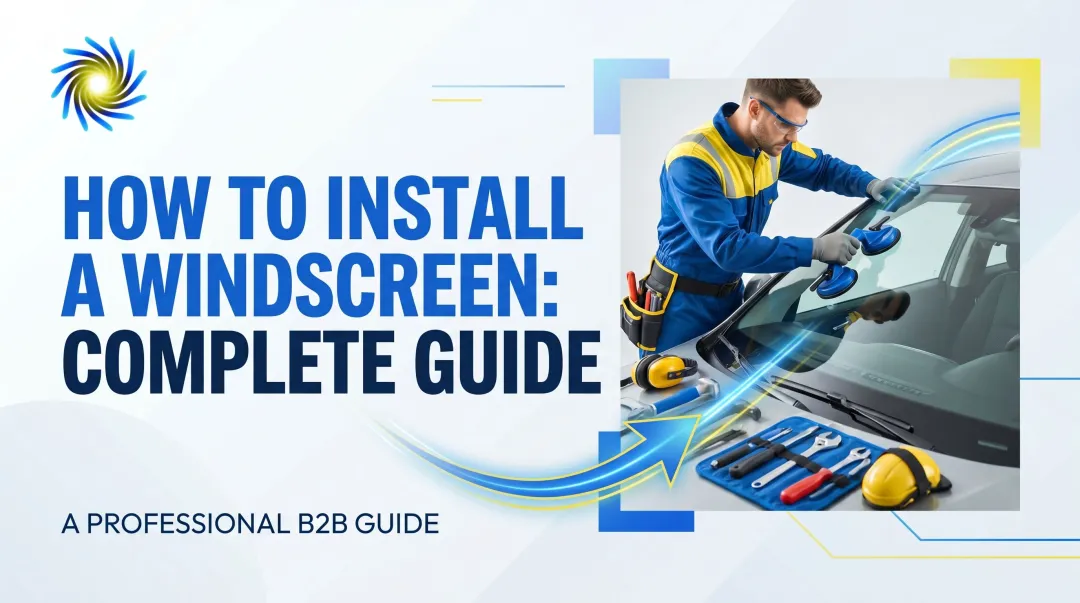
Automotive windscreen manufacturers produce laminated safety glass specifically engineered for vehicle windshields. These are large industrial glass companies operating float glass furnaces and precision lamination lines. Their products must meet federal safety standards (FMVSS 205 in the US, ECE R43 internationally) and undergo extensive optical clarity and crash-safety testing before reaching OEM assembly plants or aftermarket replacement channels.
Outdoor Windscreen Segment
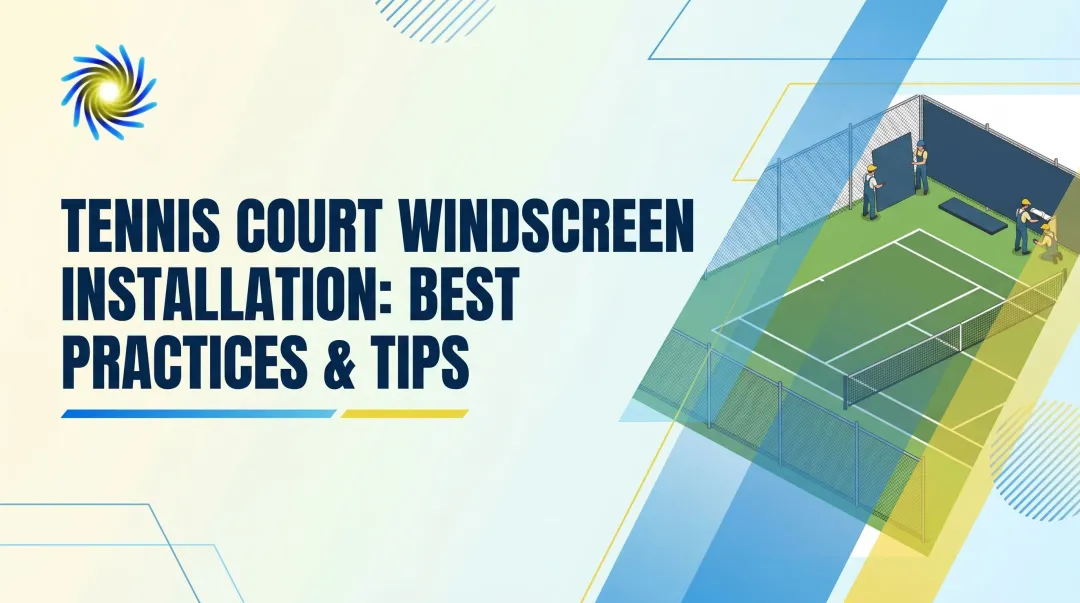
Outdoor windscreen manufacturers work with entirely different materials: knitted high-density polyethylene (HDPE), vinyl-coated polyester fabrics, and woven polypropylene mesh. These panels install on chain-link fences around tennis courts, baseball fields, construction sites, and community perimeters. They serve multiple functions—blocking wind, providing privacy, reducing debris migration, displaying sponsor logos, and enhancing facility aesthetics.
The engineering priorities look nothing like automotive glass. Outdoor manufacturers focus on:
- Breathability ratings — typically 70–95% opacity to balance airflow and visibility
- UV stabilization — preventing material degradation under continuous sunlight
- Structural load design — allowing controlled airflow to reduce stress on fence posts and fasteners
Why the Confusion Matters
Search engines don't distinguish between these industries. A procurement officer Googling "windscreen manufacturers" for a university athletic complex receives results dominated by automotive glass suppliers who cannot help them. This guide clarifies both categories but focuses on outdoor and sports windscreens — where material choices, customization options, and how manufacturers actually support buyers create the biggest differences in quality and fit.
Top Automotive Windscreen Manufacturers at a Glance
Top Windscreen Manufacturers at a Glance
The sports windscreen market looks very different from other industrial textile categories. Unlike commodity fence fabric, quality windscreens are engineered products — built from specific knitted polyethylene blends, UV-stabilized coatings, and reinforced edges designed to survive years of wind load, moisture, and sun exposure on an open field.
A handful of supplier types serve this market:
- Large-scale manufacturers — produce high-volume, generic windscreen fabric sold through distributors and big-box sporting goods channels
- Custom fabricators — cut, hem, grommet, and print to spec for individual facility orders, often with in-house design support
- Full-service providers — handle design, fabrication, custom branding, and professional installation as a single turnkey engagement
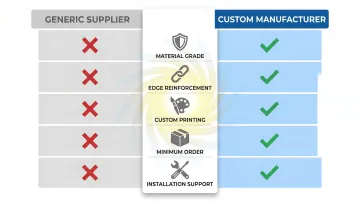
What Separates Generic Suppliers from Custom Manufacturers
Most facilities start by pricing out generic windscreen rolls from a wholesale supplier. The material is inexpensive, but it arrives without branding, in standard widths, and with no installation support. Facilities then piece together contractors separately — adding cost and coordination overhead.
Custom manufacturers like The Windscreen Factory take a different approach. Every order is built to the field's exact dimensions, and in-house industrial printing means school logos, sponsor graphics, and team colors go directly onto the screen during fabrication. No third-party print shop, no misaligned patches.
Key differences buyers should evaluate:
- Material grade — look for UV-stabilized, knitted polyethylene with at least 85% windbreak rating
- Edge reinforcement — double-stitched hems and brass grommets every 12–18 inches hold up to wind stress; cheaper screens use plastic grommets that crack
- Custom printing — dye-sublimation or direct-print options affect color vibrancy and fade resistance over time
- Minimum order requirements — large manufacturers often require bulk minimums that don't work for a single field replacement
- Installation capability — many suppliers drop-ship only; full-service providers handle tensioning, attachment, and post-installation adjustments
Branded vs. Unbranded Windscreens
The equivalent of "OEM vs. aftermarket" in the sports windscreen world is the choice between branded custom screens and generic stock product.
Branded, custom-fabricated windscreens cost more upfront but deliver measurable facility benefits: consistent team identity, sponsor visibility, and a finished look that reflects well on the program. Generic screens fulfill the functional windbreak purpose but leave branding and aesthetics off the table entirely.
For schools, parks departments, and athletic complexes investing in long-term facility upgrades, the custom route typically offers better value — the screen doubles as signage, and quality fabrication extends service life well past the 3–5 year average for commodity alternatives.
Outdoor and Sports Windscreen Manufacturers: A Different Breed
Material Engineering Fundamentals
Outdoor windscreen manufacturers don't melt glass or operate lamination presses. They work with textile and polymer technologies:
Primary Materials:
| Material | Opacity | Weight | Typical Lifespan | Best Use |
|---|---|---|---|---|
| Knitted HDPE mesh | 70-80% | 8.25-9.5 oz/sq yd | 1-2 years (commodity) to 7+ years (UV-stabilized) | Budget installations, construction sites |
| Vinyl-coated polyester (standard) | 75-80% | 8-9 oz/sq yd | 3-5 years | General tennis court and field use |
| Vinyl-coated polyester (heavy-duty) | 80-85% | 10 oz/sq yd | 5-8 years | Permanent installations, high-wind areas |
| Woven polypropylene | 90-95% | Varies | 8-10 years | Maximum privacy, visual blocking |
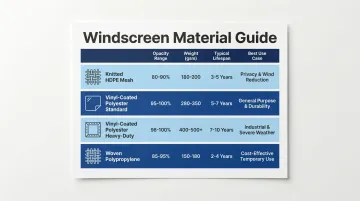
These materials are engineered for opposing demands: they must block wind and visibility while remaining breathable enough to prevent catastrophic wind load on fence structures. A 95% opacity screen blocks nearly all sight lines but creates significant stress on posts during storms. A 70% screen allows more airflow but provides less privacy.
Product Lines and Applications
Quality outdoor manufacturers typically serve multiple facility types:
- Tennis and pickleball courts — Privacy screens, court dividers, branded panels
- Baseball and softball fields — Outfield fence screens, backstop padding integration
- Construction sites — Debris containment, dust control, temporary privacy barriers
- HOA and residential perimeters — Community boundary screening, aesthetic enhancement
- Multi-sport complexes — Coordinated branding across multiple field types
Full-Service vs. Commodity Manufacturers
The outdoor windscreen market splits sharply between two business models:
Commodity suppliers produce standard roll stock in limited colors and sizes. Buyers purchase by the linear foot, handle their own installation, and coordinate separately for any custom printing or branding.
Full-service manufacturers handle everything from custom sizing to on-site installation. That includes in-house printing for logos and sponsor graphics, reinforced edge construction with grommets, and on-site measurement before production begins. The Windscreen Factory, for instance, provides Photoshop renderings so athletic directors can see exactly what a finished installation looks like before approving the order.
For multi-site projects or facilities where branding consistency affects community perception and sponsorship appeal, this service-model difference often carries more weight than material specifications alone.
What Separates Quality Windscreen Manufacturers from Average Ones
Materials and Durability Standards
UV degradation is the primary killer of outdoor windscreens. Sunlight triggers photo-oxidative chain scission (essentially, molecular bond breakdown) in polyethylene, breaking polymer bonds and causing brittleness, color fade, and mechanical failure. Quality manufacturers combat this through UV stabilizers—particularly Hindered Amine Light Stabilizers (HALS)—that dissipate harmful wavelengths before degradation begins.
Key durability markers:
- UV-stabilized HDPE or vinyl-coated polyester with documented additive percentages
- Mildew-resistant coatings to prevent biological degradation in humid climates
- Double-stitched or reinforced edges with 2-ply webbing to prevent tearing at stress points
- Brass or stainless steel grommets spaced every 12-24 inches for secure, distributed attachment
A commodity HDPE screen without UV stabilization may fade and crack within 1-2 seasons in high-sun regions like Florida or Arizona. A premium UV-stabilized product with proper edge reinforcement can deliver 7-10 years of service in the same environment.
Certifications and Safety Compliance
For facilities serving children—schools, public parks, recreation centers—CPSIA compliance is critical. Federal law limits total lead content to 100 ppm in children's products, with additional restrictions on eight phthalates (maximum 0.1% each). While CPSC enforcement targeting outdoor windscreens is rare, the statutory framework applies to any product accessible to children under 12.
The Windscreen Factory maintains CPSIA certification with lead levels far below 100 ppm and full phthalate compliance, making its products appropriate for K-12 athletic facilities and municipal playgrounds. Schools accepting donated equipment or purchasing from uncertified suppliers risk installing non-compliant materials in areas subject to federal children's product safety rules.
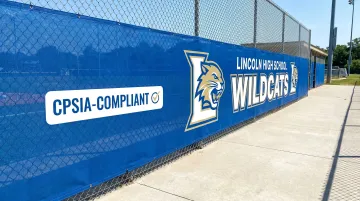
Once compliance requirements are met, customization is where manufacturers separate on actual value.
Customization Capabilities
Commodity manufacturers offer 4-6 standard colors and fixed panel sizes. Quality manufacturers provide:
- Custom sizing to exact fence dimensions, eliminating waste and installation gaps
- In-house digital printing for team logos, sponsor branding, and full-color graphics
- Photoshop mockups so clients can visualize the finished product before production begins
- Flame-retardant options meeting ASTM E-84 and NFPA-701 standards for indoor facilities
For universities, sports complexes, and corporate campuses where branding affects fundraising and community identity, the ability to print high-resolution graphics with UV-protected ink directly onto windscreen material often justifies premium pricing over generic mesh.
Production Scale and Fulfillment
A manufacturer's production capacity determines lead times and project feasibility. The gap becomes obvious at scale:
- Small fabricators often struggle with orders exceeding 500 linear feet or multi-site rollouts requiring coordinated delivery
- Large-scale manufacturers with industrial printing equipment and professional installation crews can handle 10+ fields simultaneously, with consistent branding across every location
Quality Control and Warranty
Credible manufacturers back their products with measurable commitments:
- Material warranties ranging from 1 year (commodity HDPE) to 5+ years (premium vinyl-coated polyester)
- Expected lifespan disclosures that separate warranty period from realistic service life
- Replacement policies addressing manufacturing defects vs. installation damage vs. weather wear
Warranties signal manufacturer confidence in material science and production consistency. A 7-year warranty on knitted HDPE indicates UV stabilizer formulations and construction techniques that have held up across real installations in high-sun, high-wind, and high-humidity environments — not just controlled lab tests.
How to Choose the Right Windscreen Manufacturer for Your Project
Define Your Application First
Material selection flows directly from intended use:
- Tennis court privacy — 80-85% opacity vinyl-coated polyester balances visibility blocking with breathability; custom printing for club branding
- Baseball outfield fence — 75-80% opacity allows coaches and parents to see through while reducing sun glare for fielders
- Construction site barrier — 88-95% opacity HDPE blocks debris and provides maximum privacy; short-term durability (1-2 years) acceptable
- Permanent HOA perimeter — 90-95% opacity polypropylene with 8-10 year lifespan and low maintenance requirements
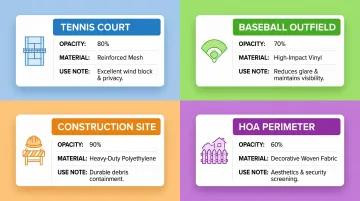
The application determines not just opacity but also edge reinforcement needs, grommet spacing, wind load tolerance, and whether flame retardancy matters for indoor batting cages or covered facilities.
Evaluate End-to-End Service Offerings
Purchasing windscreen material separately from installation creates coordination risks: incorrect measurements, incompatible fasteners, mismatched grommets, and installation errors that void material warranties. A full-service manufacturer eliminates those risks by handling:
- On-site measurement before fabrication begins
- Custom sizing and edge finishing with grommets pre-installed at correct spacing
- Professional installation by trained crews familiar with the specific product
- Design visualization through photoshop renderings or 3D mockups
The Windscreen Factory offers this end-to-end service for schools, sports complexes, and commercial clients nationwide, covering everything from initial design consultation through final installation and post-sale support. One point of contact for design, fabrication, and installation means fewer handoff errors and a finished product that matches the approved plan.
Confirm Material Testing and Climate Suitability
Ask manufacturers whether their materials have been tested or field-proven in climates similar to your site. Coastal environments corrode metal grommets faster. High-UV regions like the Southwest or Florida require aggressive UV stabilization, and high-wind areas need lower opacity or reinforced construction to protect the fence itself.
Request documentation of:
- ASTM G154 or D4329 UV weathering test results for outdoor fabrics
- Tensile strength and break strength specifications for the specific material weight you're considering
- Case studies or references from installations in similar climates
A manufacturer with a 7-year track record in Arizona sun or Gulf Coast humidity provides more assurance than one citing only laboratory test data.
Consider Total Cost of Ownership, Not Just Unit Price
A $200 commodity windscreen that lasts 18 months costs $1,333 per decade. A $450 premium product lasting 7 years costs $643 per decade, less than half the long-term cost. Add labor costs for repeated removal, replacement, and reinstallation, and the gap widens further.
Quality windscreens reduce operational costs through:
- Fewer replacement cycles (labor savings)
- Lower maintenance burden (no broken ties or sagging panels to fix mid-season)
- Sustained appearance (no fading or tearing that creates poor facility perception)
- Warranty coverage that protects against defects
For permanent installations at schools or municipal facilities operating on multi-year budget cycles, the 5-10 year total cost of ownership should drive purchasing decisions—not the lowest bid on a single replacement cycle.
Frequently Asked Questions
What are good windshield brands?
For outdoor sports facilities, the most reputable windscreen manufacturers supply knitted HDPE or vinyl-coated polyester mesh products built specifically for fence and barrier applications. Look for suppliers with proven track records in UV resistance, custom printing capabilities, and sport-specific sizing — and confirm they serve institutional buyers like schools, parks departments, and athletic complexes.
Can windscreens be customized with logos or branding?
Yes. Most quality windscreen manufacturers offer full-color custom printing directly on the mesh fabric. Logos, team names, sponsor graphics, and facility branding can all be incorporated. The Windscreen Factory, for example, provides in-house design and Photoshop renderings so clients can visualize the finished product before production begins.
How long do outdoor windscreens typically last?
A quality outdoor windscreen made from commercial-grade HDPE or polyester mesh typically lasts 5–10 years under normal conditions. Longevity depends on material weight, UV stabilization, installation method, and local climate. Heavier weave densities and reinforced edges extend product life, particularly in high-wind or coastal environments.
What sports and facilities are outdoor windscreens used for?
Outdoor windscreens are used across a wide range of sports and venues — including baseball, softball, tennis, pickleball, soccer, lacrosse, football, and basketball facilities. They're also installed along construction site fencing and in HOA communities for privacy. Schools, parks departments, municipal complexes, and private clubs are the most common buyers.
What is the difference between a windscreen and a windshield?
In automotive contexts, the terms are interchangeable—windscreen is British English, windshield is American English. In outdoor and sports contexts, "windscreen" refers to mesh or fabric panels installed on fences and athletic facility structures — not vehicle glass. Companies like The Windscreen Factory operate exclusively in this outdoor product category.
What materials are used in outdoor sports windscreens?
Quality outdoor windscreens use knitted high-density polyethylene (HDPE) or vinyl-coated polyester mesh — both breathable, UV-resistant, and mildew-resistant for long-term outdoor use. Material weight and weave density determine opacity, durability, and wind resistance.