Material choice directly affects net longevity, impact absorption, weather performance, and total cost of ownership. At #36 gauge, nylon delivers 339 lb breaking strength versus HDPE's 228 lb — yet HDPE never absorbs water and resists UV degradation naturally. Understanding these tradeoffs helps you match net type to your facility's use pattern, environment, and budget.
Key Takeaways
- Nylon costs more upfront but delivers superior tensile strength, better impact absorption, and the longest lifespan under heavy training use
- HDPE never absorbs water, resists UV degradation naturally, and works well for recreational or light-use outdoor cages
- For indoor facilities, nylon outperforms on every metric; outdoors, UV-treated nylon is a strong match for HDPE
- Pick your material based on use frequency, player level, setting, and long-term budget — not just sticker price
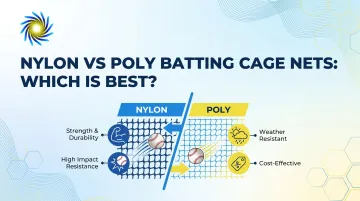
Nylon vs. Poly Batting Cage Nets: Quick Comparison
Here's how nylon and HDPE poly nets stack up across the factors that matter most to buyers.
Cost: HDPE generally costs less at purchase. Nylon commands a premium, but when you divide the higher price by a longer lifespan, the cost-per-year often favors nylon for facilities with regular use. The tensile strength data below shows exactly why that premium exists:
Tensile Strength by Gauge
| Gauge | Diameter | HDPE (Poly) | Basic Nylon | Premium Nylon (DuPont 66-728) |
|---|---|---|---|---|
| #21 | 2.0 mm | 168 lb | 209 lb | 241 lb |
| #36 | 2.5 mm | 228 lb | 339 lb | 381 lb |
| #42 | 2.7 mm | 220–392 lb* | 369 lb | 407 lb |
| #60 | 3.0 mm | N/A | 560 lb | 619 lb |
*HDPE quality varies widely by manufacturer: standard #42 HDPE tests at 220 lb, while "Ultra" grades reach 392 lb.
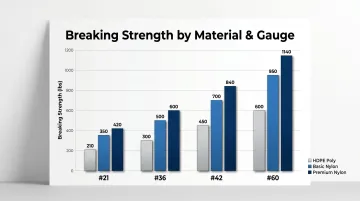
Those strength differences translate directly into how long each net lasts under daily use.
Durability & Lifespan
- #36 HDPE: 4–6 years
- #36 basic nylon: 6–8 years
- #36 premium nylon: 7–9 years
- #42 treated nylon: 6+ years
- #36 bonded nylon can maintain >50% tensile strength for 10 years, with typical replacement at 10–12 years
Weather Resistance
For outdoor installations, moisture and UV exposure are the deciding factors. HDPE doesn't absorb moisture, holds its shape in rain and snow, and maintains color under UV exposure. Untreated nylon can lose breaking strength at up to 20% per year when exposed to constant moisture, though UV-treated or black nylon closes this gap significantly.
What is Nylon Batting Cage Netting?
Nylon is a synthetic fiber known for its strength, elasticity, and ability to absorb repeated impact — exactly what batting cage nets need to survive thousands of high-velocity ball strikes.
Gauge Definitions:
Gauge refers to twine diameter. Higher numbers mean thicker, stronger netting:
- #36 (2.5 mm): All-around choice for high school through collegiate use
- #42 (2.7 mm): Advanced and professional practice environments
- #60 (3.0 mm): Permanent commercial installations and elite training facilities
When a baseball hits nylon netting, the fibers flex and spread force across surrounding strands rather than concentrating stress at the point of impact. That built-in give reduces wear and extends net life — which is why nylon is the standard in most MLB and NCAA indoor facilities.
One real limitation: untreated nylon absorbs water and breaks down under prolonged UV exposure. UV-treated or black nylon addresses this — black nylon nets can last 2–3 times longer than colored nets outdoors because black tar finishes and inside-out dyeing protect each fiber from sun damage.
Nylon is the go-to material for:
- Indoor training facilities and commercial batting cage centers
- School, university, and club athletic programs
- Professional team practice environments
The Windscreen Factory supplies custom nylon batting cage nets in gauges from #21 through #96, with dimensions up to 15×200 feet, configured to your facility's exact specifications.
What is Poly (HDPE) Batting Cage Netting?
High-Density Polyethylene is a plastic-derived material with UV inhibitors molded into the fibers during manufacturing. Because HDPE does not absorb water, it will not shrink or rot in outdoor, high-humidity, or snowy conditions.
HDPE holds up well over time, though a few performance tradeoffs are worth knowing before you buy:
- Maintains color and structural shape with minimal strength loss over its lifespan
- UV protection is integrated into the fiber, making it naturally suited to outdoor installations
- Breaking strength is lower than nylon at equivalent gauges
- Quality varies significantly by manufacturer — not all HDPE nets are built the same
Where HDPE falls short: Its melting point (125–135°C) is considerably lower than nylon's (220–225°C), which can affect performance in persistent heat or arid climates. It's also less effective at absorbing high-velocity impacts, making it a poor fit for power hitters or high-frequency training where repeated ball strikes concentrate stress in one area.
HDPE is a solid choice when the installation is light-use or cost-sensitive:
- Recreational backyard cages with occasional use
- Community park installations and municipal light-use facilities
- Budget-conscious setups that don't see daily ball strikes
- Spectator safety barriers and enclosures where impact intensity is low
Nylon vs. Poly: Which One Should You Choose?
Decision Factors:
Your choice hinges on four variables:
- Frequency and intensity of use — daily high-impact or occasional recreational
- Environment — indoor or outdoor installation
- Budget — upfront cost vs. long-term value
- User level — recreational youth or collegiate/professional athletes
Choose Nylon If:
- The cage will be used daily or near-daily
- Players are high school age or older with significant bat speed
- The facility is indoors or the owner wants maximum longevity
- The setup is commercial or institutional
ASTM F2225 specifications for batting cages list nylon as the recommended material, with poly described as "hobby-grade." Nylon's higher initial cost typically yields a lower cost-per-year when spread across its lifespan.
Choose HDPE If:
- The cage is for recreational or occasional use
- Budget is limited and the setup is for younger or lighter hitters
- The installation is permanently outdoor in a wet or snowy climate
- The application is a safety barrier rather than a primary hitting enclosure
Indoor vs. Outdoor Considerations
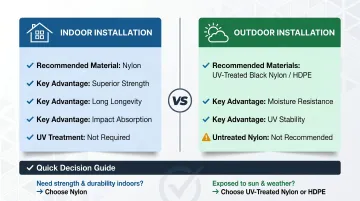
Environment — one of the four decision factors above — shifts the calculus more than most buyers expect. Indoors, nylon wins on strength, longevity, and impact feel. Outdoors, the tradeoffs become more nuanced: UV-treated black nylon competes with HDPE for outdoor durability, but untreated nylon loses ground quickly. Always confirm whether a nylon net is UV-treated before purchasing for outdoor use.
Gauge-Material Interaction
Material choice and gauge work together — neither variable stands alone. A heavy-gauge HDPE net (such as #42 "Ultra" at 392 lb breaking strength) may outperform a light-gauge basic nylon net in some scenarios. Evaluate both dimensions together before making a final call.
Need help specifying the right combination for your facility? The Windscreen Factory works with schools, parks departments, and athletic programs to match netting material and gauge to exact use patterns, player levels, and environmental conditions. Reach out at sales@thewindscreenfactory.com or call 888.619.2228.
Conclusion
Nylon is the stronger, longer-lasting, and more impact-resilient option — best for facilities training seriously, operating commercially, or investing in a setup meant to last a decade. HDPE earns its place in recreational, outdoor-only, or budget-constrained contexts where light use is the norm.
That verdict, though, depends entirely on your context. When in doubt, filter by use frequency and player level:
- High school team, five days a week indoors: #42 nylon delivers the strength and shock absorption that heavy daily use demands
- Backyard cage, weekend youth play: #36 HDPE holds up well at a lower upfront cost
Once you know which material fits your setup, getting the configuration right matters just as much. The Windscreen Factory works with sports facilities, schools, and athletic programs to specify and configure custom batting cage netting for their exact needs — including design consultation, on-site measurements, and professional installation.
Frequently Asked Questions
What is the best material for a batting cage net?
Nylon is the best material for batting cage nets due to its superior tensile strength and impact absorption, particularly for high-frequency practice or competitive training. HDPE suits lighter recreational setups where budget and outdoor weather resistance are priorities.
How long do nylon batting cage nets last?
Lifespan depends on gauge and usage frequency. A #36 nylon net used regularly lasts 4–6 years, #42 around 5–7 years, and #60 can exceed 8–10 years under proper maintenance. Premium bonded nylon can maintain performance for a decade or longer.
Is HDPE or nylon better for outdoor batting cages?
HDPE is naturally UV-resistant and doesn't absorb water, making it lower-maintenance outdoors. UV-treated black nylon is also a strong outdoor option and offers better impact performance — untreated nylon is better reserved for indoor installations.
What gauge nylon batting cage net should I buy?
#36 is a popular all-around choice for youth through collegiate use, #42 suits advanced and professional practice, and #60 is ideal for permanent commercial installations requiring maximum durability. Higher gauge numbers mean thicker, stronger netting.
Are poly batting cage nets worth it?
Poly nets offer good value for recreational, light-use, or budget-constrained setups. Lower tensile strength means faster wear under heavy use, but they perform well outdoors where moisture and UV exposure are ongoing concerns.
Can you use a batting cage net outdoors year-round?
Both UV-treated nylon and HDPE nets can be used outdoors year-round. Inspect for UV degradation, fraying, or sag seasonally, and store or cover nets during extended off-seasons to extend lifespan. Replace any net when breaking strength drops below 60 lb.