
Despite its foundational role, signage is routinely treated as an afterthought in facility planning. According to the authoritative "Signage and Wayfinding Design" textbook by Calori and Vanden-Eynden, signs historically "tended to pop up in an ad hoc, unplanned, almost reactionary manner—in other words, pretty much as an afterthought." Yet signage directly affects crowd flow, brand perception, safety outcomes, and even concession revenue.
This article examines the measurable, operational impact wayfinding delivers for venues of all sizes. Whether you manage a large arena, a school athletic complex, or a community park system, the principles and outcomes are the same: effective signage isn't decoration—it's infrastructure that drives experience, revenue, and safety.
Key Takeaways
- Strategic wayfinding does more than point people to the bathroom — it shapes the entire fan experience and reinforces your brand at every turn
- Well-executed signage measurably improves fan satisfaction and keeps people coming back
- Signage placement directly impacts concession sales and sponsor visibility — both revenue drivers facilities often underestimate
- Clear wayfinding is a legal requirement for ADA compliance and emergency evacuation
- Ignoring signage isn't just an experience problem — it creates bottlenecks, kills concession traffic, and opens the door to ADA violations
What Is Wayfinding and Signage at a Sports Venue?
Wayfinding is the intentional system of visual, spatial, and informational cues—including signage—that helps visitors orient themselves and navigate a facility confidently. A well-designed wayfinding system answers three questions at every decision point: Where am I? Where am I going? How do I get there? Every sign, marker, and directional element should work toward those answers.
The Four Core Types of Sports Venue Signage:
| Type | Function | Examples |
|---|---|---|
| Identification | Confirms location ("You are here") | Section markers, gate numbers, restroom labels |
| Directional | Guides toward destinations | Arrows to seating, concessions, exits |
| Informational | Provides facility details | Event schedules, venue maps, Wi-Fi info |
| Regulatory | Communicates rules and safety | Emergency exits, ADA markers, "No Re-Entry" |
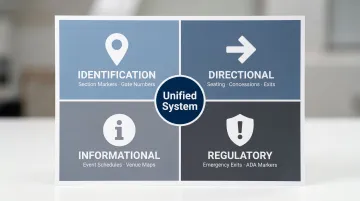
All four types must work together as a unified system. A directional sign pointing to Section C means nothing if the section itself isn't clearly identified when you arrive.
When these elements are coordinated — consistent colors, typography, placement logic — visitors spend less time confused and more time engaged with the event itself.
Key Advantages of Wayfinding and Signage for Sports Venues
The benefits below aren't abstract design advantages. They're real operational and experiential outcomes that venue managers, athletic directors, and facility operators measure and track.
Enhanced Fan Experience and Visitor Satisfaction
A fan who can effortlessly find their seat, the nearest restroom, and the concession stand without asking for help is a fan who spends more time enjoying the event—and more likely to return. Contrast this with a first-time visitor lost in a maze of identical corridors, frustration mounting with every wrong turn.
Strategic wayfinding creates this advantage through:
- Placement of signs at decision points (entrances, intersections, stairwells)
- Consistent visual language across the facility
- Clear information hierarchy preventing cognitive overload
Deloitte's 2018 Fan Engagement Survey found that "basics" like stadium navigation, concession cost, and concession quality "typically score low in satisfaction," even though fans weighted these core factors 50% higher than all other experience elements. The gap between what fans expect and what venues deliver is measurable—and fixable.
Reduced navigation friction translates directly to:
- Higher satisfaction scores and repeat attendance rates
- Fewer staff hours spent giving directional assistance
- Shorter lines due to better crowd distribution across amenities
- Higher time spent at concession and merchandise areas
KPIs impacted: Fan satisfaction scores, repeat attendance rates, staff time allocation, concession dwell time
When this advantage matters most: Large-scale events with first-time visitors, multi-sport complexes hosting back-to-back events, venues serving diverse audiences including families, seniors, and international guests
Brand Identity Reinforcement and Revenue Generation
Every sign is a brand touchpoint — not a neutral utility. A venue with cohesive, on-brand signage communicates professionalism and pride. Generic or mismatched signs undermine the facility's identity and the teams it hosts.
Using team colors, typography, logos, and imagery throughout directional and decorative signage creates an immersive environment. Visitors feel they're somewhere deliberate and distinct, not another generic concrete facility.
Revenue is directly influenced by signage in multiple ways:
- Concession and merchandise visibility increases impulse purchases
- Sponsored signage panels and digital displays generate advertising income
- Branded environments elevate perceived venue value, supporting ticket pricing and event booking rates
When Mercedes-Benz Stadium opened with fan-centric concourse design—including improved concession visibility—per-capita fan spending increased 16% in the first season and merchandise sales rose more than 80%.
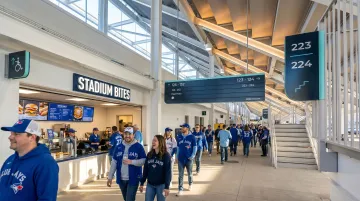
For outdoor athletic facilities, custom-branded physical elements—such as printed windscreens, fence banners, and facility graphics from providers like The Windscreen Factory—extend brand identity across the entire venue footprint, not just interior walls. These durable, weather-resistant branded elements turn perimeter fencing and courts into continuous brand impressions.
KPIs impacted: Per-fan concession and merchandise spend, sponsorship revenue, event booking rate, brand recognition scores
When this advantage matters most: Multi-tenant facilities sharing space with different teams, venues seeking corporate sponsors, school or park athletic complexes building community pride
Safety, Crowd Control, and Operational Efficiency
Brand value means little if crowd management fails. Clear wayfinding prevents bottlenecks during normal operations and keeps foot traffic moving efficiently. In an emergency, well-placed exit and evacuation signage is the difference between an orderly exit and a dangerous one.
How effective signage creates operational advantages:
- Staff can be deployed strategically rather than stationed throughout answering directional questions
- Regulatory signage (ADA compliance, wet floor warnings, emergency exits) reduces liability exposure
- Digital signs can be updated in real-time to redirect crowds or broadcast urgent safety messages
Crowd management failures—bottlenecks at exits, confusion at entry gates, inaccessible routes for visitors with mobility challenges—are both safety risks and compliance liabilities.
Levi's Stadium paid a record $24 million settlement in 2019 for ADA violations including 2,600+ physical impediments. Qualcomm Stadium cost San Diego taxpayers more than $10 million in upgrades and subsidies for non-compliance. These costs dwarf proactive investment in accessible signage.
ADA requirements include:
- Tactile signs (raised characters and Braille) at exits, stairways, and permanent rooms
- High-contrast, non-glare finish on all signs
- Specific mounting heights and clearances
- International Symbol of Access for assistive listening systems
Beyond legal compliance, University of Greenwich research found that only 38% of building occupants detected standard emergency exit signs—yet those who did made decisions 115% faster at wayfinding decision points. Sign visibility must be actively engineered, not assumed.
79% of people with disabilities identify as sports fans, and they spend an average of $61 more per person on Big Five pro leagues than the general population. Accessible signage isn't just a compliance checkbox — it's a revenue opportunity most venues underestimate.
KPIs impacted: Emergency evacuation times, ADA compliance status, event-day staffing requirements, incident/injury rates, crowd flow efficiency
When this advantage matters most: High-attendance events, multi-entrance venues, outdoor complexes with large perimeters, facilities serving visitors with disabilities or limited mobility
What Happens When Wayfinding Is Missing or Ignored
Poor signage has measurable costs. Fans arrive disoriented, staff abandon their primary roles to give directions, and bottlenecks form at unmarked entry and exit points. The first impression becomes confusion instead of excitement.
Revenue and reputational consequences:
- Concession and merchandise sales underperform when fans can't find them easily
- Sponsor placements lose impact without cohesive branding to anchor them
- Generic, inconsistent design makes a venue forgettable — cutting repeat visits and referrals
Risk exposure:
Outdated or missing regulatory and ADA-compliant signage creates legal liability. Unclear emergency exit routes can result in injuries during evacuations. The absence of visible safety signage around hazardous areas (pools, playing surfaces, parking lots) puts the facility in legal and ethical jeopardy.
Crowd scientist Keith Still identified "poor signage" and "lack of wayfinding" as part of the "underlying fundamentals" of crowd disasters. That puts wayfinding in the same category as emergency lighting or fire suppression — infrastructure that protects people, not just a finishing touch.
How to Get the Most Value from Wayfinding and Signage
Start with a site audit: walk every visitor journey from parking to seat, seat to concession, and exit during emergencies. You're looking for friction points — congestion spots, decision points without clear direction, gaps in ADA compliance, and missed branding opportunities.
Pull input from staff, regular attendees, and first-time visitors. Each group notices different things, and a complete picture requires all three perspectives.
Build a unified system:
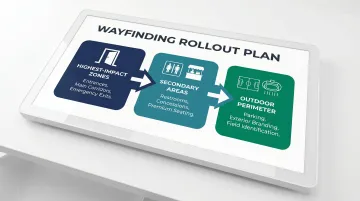
Signage should follow a consistent visual language (colors, fonts, icons, tone) tied to the venue's brand identity. Plan in phases:
- Phase 1: Highest-impact zones (entrances, main corridors, emergency exits)
- Phase 2: Secondary areas (restrooms, concessions, premium seating)
- Phase 3: Outdoor perimeter (parking, exterior branding, field identification)
Execution matters as much as planning. Working with a full-service provider that offers design visualization (Photoshop renderings before fabrication), custom fabrication, and professional installation ensures the finished product matches the plan and holds up over time. The Windscreen Factory, for example, handles everything in-house: design support, on-site measurements, and installation across signage types ranging from fence banners and printed windscreens to custom wall murals.
Plan for ongoing maintenance and updates:
- Conduct regular reviews after events to assess what worked and what confused visitors
- Refresh signage as branding evolves or venues add new amenities
- Ensure outdoor elements (banners, printed windscreens, fencing graphics) are replaced before weathering degrades visual clarity
Conclusion
Effective wayfinding and signage deliver value across three interconnected dimensions: they improve the fan experience, reinforce and monetize the venue's brand identity, and ensure safe, efficient operations. Done well, these dimensions reinforce each other — better navigation reduces staff burden, stronger branding drives sponsor interest, and clearer safety signage cuts incident liability.
Venues of all sizes — from professional arenas to school athletic complexes — benefit from treating signage as a strategic investment rather than an afterthought. The facilities that get this right don't just look polished on opening day; they build reputations that bring fans, teams, and sponsors back season after season.
Frequently Asked Questions
What are the four main types of signage a sports venue needs?
Identification signs confirm current location (section markers, gate numbers), directional signs guide toward destinations (arrows to seating, exits), informational signs provide facility details (event schedules, maps), and regulatory signs communicate rules and safety (emergency exits, ADA markers). Each type serves a distinct function, and gaps in any one category tend to show up as fan complaints about confusion or missed amenities.
How does wayfinding signage improve the fan experience at a sports event?
Intuitive navigation reduces frustration, frees up fan time for enjoying the event rather than searching for amenities, and increases satisfaction scores. Deloitte research links strong navigation directly to higher repeat attendance rates — fans who don't struggle to find their seats or the nearest concession stand are more likely to come back.
Can smaller sports complexes, school athletic facilities, or parks benefit from a wayfinding system?
Any multi-field or multi-use facility benefits from clear wayfinding. NRPA research found that design and ambiance (including signage) was the only physical variable significantly correlated with public awareness of park facilities. Banners, printed windscreens, and fencing graphics offer a cost-effective entry point for smaller venues without a full digital signage budget.
How does signage help a sports venue generate revenue?
Signage drives revenue by directing fans to concessions and merchandise, creating high-visibility sponsor placements, and elevating perceived venue quality to support ticket pricing and event bookings. Mercedes-Benz Stadium saw 16% per-capita spending increases after improving concession visibility alone.
What is ADA-compliant signage and why does it matter for sports venues?
ADA-compliant signage includes tactile, Braille, and high-contrast elements that make facilities accessible for visually impaired and mobility-limited guests. Non-compliance carries real legal risk (Levi's Stadium paid $24 million in ADA settlements) and shuts out the 79% of people with disabilities who identify as sports fans and spend above average per event.
How often should sports venue signage be updated or replaced?
Signage should be reviewed after major events or rebrands. Outdoor elements should be inspected seasonally for weather damage, with replacement before degradation impacts visual clarity. Digital or modular systems allow for more frequent low-cost updates without replacing entire installations.