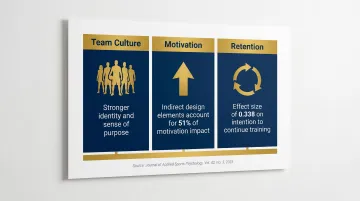
Many facility managers invest heavily in quality fields, courts, and equipment but overlook branding as a strategic tool. This leaves a powerful opportunity untapped—one that shapes athlete motivation, influences recruiting outcomes, and generates sponsorship revenue. Research shows that indirect design elements like colors and visual patterns are the strongest predictor of athletes' intention to continue training in a facility, accounting for 51% of the total design impact on motivation.
This guide covers why branding matters, which surfaces to prioritize, how outdoor elements like windscreens and padding serve dual functions, and how to plan a cohesive branding project from start to finish.
Key Takeaways
- Athletic facility branding strengthens team culture and drives athlete retention and on-field performance
- High-impact branding zones include entrance areas, field perimeters, competition floors, and locker rooms
- Custom windscreens and branded padding deliver both functional value (safety, wind control) and visual identity
- Color consistency across all touchpoints creates stronger recognition and emotional connection than scattered graphics
- Map your facility's "brand journey" first — then work with a vendor who handles design, fabrication, and installation under one roof
Why Athletic Facility Branding Matters More Than You Think
Athletic facility branding isn't decorative—it actively shapes team culture. Athletes who train in visually consistent, branded environments develop stronger team identity and sense of purpose. A 2025 study of 204 athletes found that indirect design elements—materials, colors, and visual patterns—predicted athletes' intention to continue training in a facility more than any other factor, with an effect size of 0.338. The research confirmed that incorporating locality, history, and culture into spatial design fosters belonging and emotional attachment, regardless of athletes' personal environmental awareness.
That psychological pull extends beyond current athletes—it shapes how recruits, sponsors, and communities perceive your program.
Recruiting Impact
During facility tours, recruits and their families assess organizational investment and culture. A well-branded facility signals that the program takes both athlete experience and excellence seriously. Students who take a campus tour are 64% more likely to apply and 50% more likely to enroll, according to 2019 research. Campus appearance serves as a proxy for institutional quality—and athletic facilities rank among the three most influential building types during visits.
However, the novelty effect matters more than the facility itself. Analysis of Power Five programs found that recruiting rankings improved significantly the year before new football and basketball facilities opened, not after. The promotion and anticipation of a branded upgrade delivers more recruiting value than the completed structure. This means consistent, visible branding that tells a compelling story matters more than expensive architecture alone.
Community and Sponsorship Revenue
Visible, consistent branding builds recognition with local communities, alumni, and spectators. MLB teams opening new stadiums see an average 29.6% attendance increase in the inaugural season, and the effect lasts up to 21 years. Comprehensive rebranding—even without new construction—creates a similar refresh effect.
Professionally branded facilities also give sponsors a visible place to advertise. The Big 5 North American sports leagues combined for over $8 billion in sponsorship revenue in 2024-25, with NFL team sponsorship alone reaching $2.7 billion. At smaller scales, designated signage zones can offset facility costs while boosting local business visibility:
- Windscreen panels with printed sponsor logos along the outfield or sideline fence
- Padded wall sections displaying sponsor branding in high-traffic areas
- Perimeter fencing graphics visible to both in-venue crowds and passing traffic
Long-Term Asset Value
Brand identity is increasingly recognized as an intangible asset that contributes to facility valuation. PwC projects that over the next decade, at least 50% of major league teams will operate within sports-anchored mixed-use districts, and facilities with strong brand identities attract institutional investment. The same logic applies to high schools, municipal parks, and college programs: a cohesive, branded facility commands higher perceived value than one with fragmented or absent identity.
Key Indoor Branding Touchpoints in Athletic Facilities
A facility's brand should be felt across every space — from the front entrance to the locker room. The indoor zones below deliver the highest return on branding investment, whether you're trying to impress recruits, motivate athletes, or build community pride.
Entrance and Lobby Areas
The entrance is your most important first-impression zone. Recruits, opponents, and community members all form their impression here. Recommend using:
- Dimensional logo signs mounted above entrance doors
- Large-format wall graphics featuring team colors and mascots
- Building wraps or window perf on glass doors and windows
Done well, an entrance communicates who you are before a visitor takes their second step inside.
Wall Graphics and Murals
Large-format wall graphics and motivational murals transform blank gymnasium and training room walls into visually charged spaces that reflect team identity. Effective applications include:
- Team mascots rendered in full color across large wall sections
- Achievement timelines showcasing championship years and record-holders
- Motivational slogans integrated with school colors and logos
- "Wall of Champions" displays recognizing athlete accomplishments
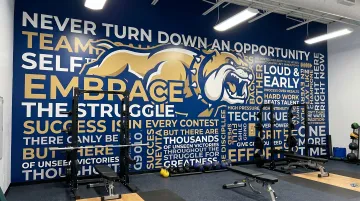
The Windscreen Factory produces custom wall murals and large-format printed graphics in-house, giving athletic departments direct control over design, scale, and turnaround — without relying on a third-party print vendor.
Locker Rooms and Athlete Spaces
Locker rooms are where team culture is reinforced daily. Branding in these private spaces creates accountability and pride within the athlete's environment. Key applications include:
- Locker door wraps featuring individual player names or team values
- Record boards displaying current and historical performance benchmarks
- Motivational quote walls aligned with team identity
- Custom floor graphics with team logos at room center
When athletes see their program's identity reflected in the space where they prepare, it reinforces standards that coaches spend years building.
Floor Graphics and Functional Signage
Floor decals serve both branding and functional purposes:
- Team logos at center court or mid-field
- Training zone markers defining workout areas
- Directional arrows for foot traffic flow
- Custom court numbers and boundary lines
The Windscreen Factory provides floor vinyl signage available in thermoplastic, Courtwrap (for temporary graphics), and Alumigraphics (for both temporary and permanent displays), all designed for durability in high-traffic environments.
Outdoor Branding: Windscreens, Padding, and Netting
Outdoor branding is the most underutilized opportunity in athletic facility design. Fields, courts, and perimeter fencing present large-scale, high-visibility space visible to passersby, spectators, and neighboring communities—making outdoor branding a continuous advertisement for your program.
Custom-Printed Windscreens
Weather-resistant windscreens printed with team logos, colors, and graphics serve double duty: wind protection, privacy, and visual backdrop — all while creating a professional branded environment. The Windscreen Factory offers 15 standard colors with custom color matching available for exact brand alignment.
Material options include:
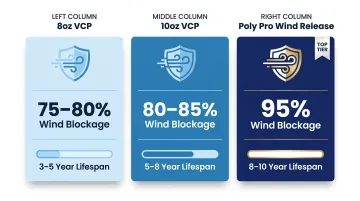
- 10oz VCP: 80-85% wind blockage, 5-8 year lifespan
- 8oz VCP: 75-80% wind blockage, 3-5 year lifespan
- Poly Pro Wind Release: 95% blockage, 8-10 year lifespan
The company provides Photoshop renderings to help facilities visualize finished products before ordering, eliminating guesswork and ensuring accurate color matching with existing branding.
Branded Padding
Custom-printed padding on backstops, outfield walls, dugouts, and goal posts is one of the most cost-effective branding upgrades available. Every padded surface becomes a branded touchpoint without sacrificing athlete safety.
The Windscreen Factory's padding includes:
- 18 oz outdoor vinyl with high-impact polyurethane foam
- Available in 1", 2", or 3" thicknesses
- Fully customizable in color, size, shape, and printed graphics
- CPSIA certified with lead levels far below 100 ppm, compliant for athletes of all ages
Branded Netting and Fencing Accessories
Custom netting configurations and perimeter fencing elements create a cohesive outdoor identity. Options include:
- Custom fence toppers (Poly-Cap, Fence Guard, Safefoam Premium, Safety Top Cap) available in team colors
- Vinyl-covered padding for fence posts and rails
- Custom-printed distance markers and field indicators integrated into windscreens
- Branded turf halos and on-deck circles for baseball facilities
The Windscreen Factory prints logos, sponsor information, and custom messaging directly onto backstops, padding, and windscreens — so every safety element pulls double duty as a branded asset.
The Role of Color and Visual Consistency in Facility Branding
Color psychology influences athlete performance and motivation in measurable ways. Elliot and Maier's Color-in-Context Theory holds that color carries context-dependent psychological meaning, with effects rooted in both biological predispositions and social learning.
Key findings:
- Red increases perceived dominance and signals competitive advantage in athletic contexts
- Blue activates alertness via the melanopsin photoreceptor system (the light-sensitive cells that regulate wakefulness and sustained focus), enhancing sustained attention
- Green positively affects mood during exercise and influences perceived exertion
- Black uniforms are associated with higher aggression levels in team sports
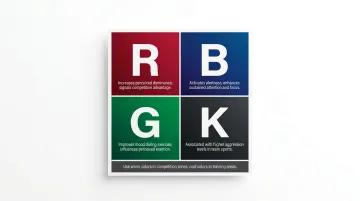
Put this to work by placing bold, high-energy colors—reds and yellows—in competition zones to drive intensity, and reserving cooler blues and greens for training areas where sustained focus matters most.
How Visual Consistency Builds a Recognizable Brand
Color decisions only pay off when applied consistently. Visual consistency across all touchpoints—same color palette, logo versions, typography, graphic style—transforms individual elements into a recognizable brand. Inconsistency, like mismatched shades of school colors on outdoor fencing versus indoor walls, erodes that recognition immediately. Brand consistency increases revenue by an estimated 10–20% across industries, yet 77% of organizations report regularly encountering off-brand content in the field.
Practical Tips for Maintaining Consistency
- Create a simple brand standards reference document before ordering any printed elements
- Specify Pantone Matching System (PMS) color codes to ensure exact color matching across vendors
- Choose UV-resistant and weather-safe inks for outdoor pieces to prevent color fading
- Always use vector logo files to ensure clarity across small and large-format applications
- Request material samples before full production to verify color accuracy under different lighting conditions
How to Plan and Execute an Athletic Facility Branding Project
Prioritization Framework
Start with highest-visibility, highest-traffic zones before expanding to secondary areas:
- Facility entrance (first impression for all visitors)
- Primary field or gym perimeter (most visible during games)
- Main competition floor or wall (focal point during events)
- Locker rooms (daily athlete immersion)
- Secondary fields and practice areas (expand as budget allows)
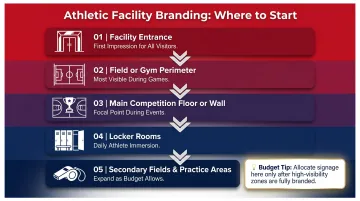
Map your facility's "brand journey" from the parking lot to the locker room, identifying every touchpoint where visitors encounter your brand.
Full-Service Vendor Approach
Providers offering design, fabrication, and installation under one roof deliver significant advantages over sourcing each element separately:
- Consistent color matching and material quality across all elements
- Single point of accountability for project timeline and quality
- Reduced coordination overhead and miscommunication between vendors
- Access to digital mock-ups and renderings before production
The Windscreen Factory handles everything from on-site measurement and Photoshop renderings to custom fabrication and installation—with in-house design staff and large-scale industrial printing under one roof.
Material and Durability Considerations
Evaluate vendors on:
- Material quality: Request specifications on vinyl weight, foam density, and substrate composition
- Weather resistance: Verify UV protection, mildew resistance, and temperature tolerance ranges
- Compliance certifications: Confirm CPSIA certification for children's safety, ASTM standards for padding impact attenuation, and NFPA-701 for fire-retardant indoor applications
- Expected lifespan: Ask about warranties and typical product life to calculate true cost-per-year
For example, The Windscreen Factory's 10oz VCP windscreens carry a 4-year warranty with a 5-8 year expected lifespan, while their Poly Pro Wind Release material offers a 4-year warranty with an 8-10 year lifespan.
Frequently Asked Questions
What exactly is athletic facility branding?
Athletic facility branding is the strategic use of visual elements—logos, colors, graphics, signage, and printed equipment—across all physical spaces. The goal is a unified, recognizable identity that reflects the team or organization's values and strengthens the overall athlete experience.
Which surfaces should I prioritize when branding an athletic facility?
Start with high-traffic, high-visibility zones: the facility entrance, primary field or gym perimeter (including windscreens and fencing), main competition floor or wall, and locker rooms. These deliver the greatest impact per dollar spent.
How do custom windscreens contribute to athletic facility branding?
Custom-printed windscreens provide functional wind and privacy protection while displaying team logos, colors, and graphics across large outdoor surfaces—making them one of the most visible and cost-effective branding elements for outdoor athletic facilities.
How does a well-branded facility help with athlete recruitment?
During facility tours, recruits and their families assess organizational investment and culture. A professional, cohesive branding environment signals that the program takes both athlete experience and excellence seriously, which can be the deciding factor when a recruit is choosing between otherwise comparable programs.
How long do branded outdoor elements like windscreens and padding typically last?
Lifespan depends on material quality, climate, and maintenance. High-quality, weather-resistant printed windscreens and outdoor padding can last 5-10 years. Prioritize materials rated for all-weather conditions and verify that your vendor meets recognized safety and material standards before ordering.
Do I need a professional designer to brand my athletic facility?
You'll need a basic brand identity—logo and color palette—before ordering materials. Many full-service vendors offer in-house design and digital renderings, so schools and smaller programs can get professional-quality results without hiring a separate design agency.