Introduction
Every season, athletic directors, facilities managers, and recreation coordinators face the same costly headache: replacing volleyball nets that should have lasted years. A school gym system that fails after 18 months costs far more than the difference between a $200 budget net and a $400 quality system. The hidden expense isn't just the replacement net — it's the administrative time, installation labor, and disruption to programs when equipment fails mid-season.
Choosing a durable volleyball net isn't about finding the cheapest option or trusting marketing claims. You need to know what separates a net that lasts two seasons from one that lasts ten — before you buy it.
This guide walks through materials, construction quality, and how to match the right net to your environment so you can make a purchase that holds up.
Key Takeaways
- Nylon and high-density polyethylene deliver the longest outdoor lifespan — nylon lasts 5-7 years with UV treatment, HDPE performs 4-6 years in harsh weather
- Indoor nets fail rapidly outdoors — moisture absorption, UV degradation, and cable corrosion accelerate breakdown
- Use intensity drives durability needs — weekly backyard play tolerates lighter materials; daily school programs require heavy-gauge mesh and commercial hardware
- Hardware quality determines system lifespan — galvanized cables, powder-coated poles, and ratchet tensioning prevent premature failure
- Higher upfront cost reduces replacement frequency — quality nets cost 2-3x more initially but last 3-5x longer than budget alternatives
What Is a Volleyball Net?
A volleyball net is the barrier strung between two poles at a regulated height that divides the court and defines fair play. When facilities managers and buyers refer to a "net," they typically mean the complete system: the mesh netting itself, the top and bottom cables or ropes, the poles or posts, tensioning hardware, and anchoring mechanisms. Each component affects how long the system performs under stress.
Types of Volleyball Nets
Four main categories dominate the market, each with distinct durability profiles:
- Indoor competition nets — Designed for gym courts with controlled temperature and humidity, prioritizing tension consistency and regulation height precision
- Outdoor recreational nets — Built for backyards, parks, and beaches with UV-stabilized materials and rust-resistant hardware
- Portable systems — Freestanding designs requiring no anchoring, typically lighter construction that trades durability for convenience
- In-ground permanent systems — Floor-sleeve or ground-sleeve installations with the most robust hardware and longest expected lifespan
Beach and outdoor nets face the most aggressive wear. UV radiation, wind load, moisture retention, and temperature cycling accelerate degradation in ways indoor environments never create. Material selection becomes critical in these settings — untreated polypropylene can show structural failure in approximately 4.5 weeks under accelerated UV testing, which is why outdoor installations demand UV-stabilized materials.
Core Components That Affect Longevity
A volleyball net system consists of five functional parts that directly determine lifespan:
- Net mesh — Nylon, polyethylene, or polypropylene woven to a specific thread gauge; weave density determines tear resistance and ball-impact load capacity
- Top cable or rope — Sets horizontal tension across the top edge; steel, galvanized steel, stainless steel, or aramid fiber (Kevlar, Technora) options vary in break strength and corrosion resistance
- Bottom cable or rope — Holds the lower edge taut and prevents the net from lifting during play; typically lighter gauge than the top cable in recreational nets
- Side tapes and edge reinforcement — Perimeter fabric bands that distribute stress across the mesh and prevent fraying; outdoor nets use reinforced vinyl over canvas to resist moisture and mildew
- Anchoring hardware — Poles, floor sleeves, ground sleeves, stakes, tensioning ratchets, and turnbuckles; rusted cables, bent poles, or failing tensioning systems are the most common cause of early replacement in both recreational and institutional settings
A net is only as durable as its weakest component.
Key Factors for Choosing a Durable Volleyball Net
Choosing a durable volleyball net means matching material, hardware, and construction to your specific setting and how often the net gets used. Schools, parks departments, and sports complexes that evaluate these factors carefully avoid the costly cycle of frequent replacements.
Net Material and Thread Construction
Three materials dominate volleyball net construction, each with distinct performance characteristics:
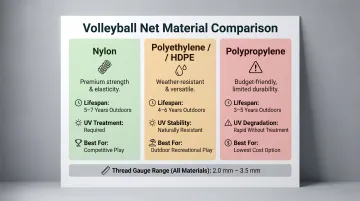
Nylon — Flexible, abrasion-resistant, and ideal for high-intensity competitive play. Nylon netting lasts approximately 5-7 years outdoors when properly UV-treated. Its key weakness is moisture absorption, which can cause stretching and sagging in wet climates. Professional competition nets favor nylon because it combines durability with the tight weave precision required for regulation play.
Polyethylene (PE/HDPE) — Stiffer than nylon but naturally UV-stable and highly water-resistant. HDPE performs for 4-6 years under comparable outdoor conditions. Its rigidity makes it less susceptible to wind-induced sagging, making PE common for outdoor recreational installations at parks and beach courts.
Polypropylene — Lightweight and the least expensive option, but also the shortest-lived. Polypropylene lasts 3-5 years outdoors, and unstabilized versions degrade rapidly under UV exposure. Research shows unstabilized polypropylene can fail in weeks when exposed to intense sunlight, not years. Never install untreated polypropylene in permanent outdoor volleyball setups.
Thread gauge determines tear resistance. The Marchants volleyball nets comparison table documents twine diameter ranging from 2.0 mm for recreational/institutional nets up to 3.5 mm for professional/championship-grade nets. Thicker thread means greater impact resistance and longer lifespan under heavy use. For high-use environments like school gyms, parks, or sports complexes, tightly woven, heavier-gauge nets in nylon or PE outlast thinner recreational-grade mesh by a wide margin.
Knotted versus knotless construction. Knotted netting ties twine at each intersection and is heat-set to lock the knots in place, creating a stronger mesh at a given twine size. Knotless netting is stitched at intersections, producing a smoother surface with less abrasion and more consistent mesh sizing. Knotless designs reduce player contact injuries but sacrifice some strength compared to knotted nets of equal thread gauge.
UV Resistance and Weather Protection
Outdoor volleyball nets degrade primarily through UV exposure, moisture retention, and temperature cycling. Without UV stabilization, nets become brittle and discolored within one or two seasons — a costly mistake facilities make when assuming all "outdoor" nets offer the same protection.
UV exposure breaks down polymer fibers over time, causing brittleness, yellowing, and surface cracking. The key question when buying any outdoor net is whether UV protection is built into the fiber at extrusion or applied as a surface coating. Fiber-integrated stabilizers (HALS) continuously neutralize UV damage and outlast surface coatings that simply wear away with weather and cleaning.
What to verify before purchasing:
- Fiber-integrated UV stabilization — compounded in at extrusion, not brushed or sprayed on after
- Mildew-resistant vinyl bands — vinyl resists moisture absorption; canvas bands (used on indoor nets) absorb water and promote mildew growth
- Treatment spec for your climate — coastal, humid, and frequently wet environments need both UV and mildew protection specified explicitly
Hardware Quality: Cables, Poles, and Tensioning Systems
The net mesh often outlasts the hardware. Rusted cables, bent poles, and failing tensioning systems are the most common cause of early replacement in both recreational and institutional settings.
Cable strength and material hierarchy:
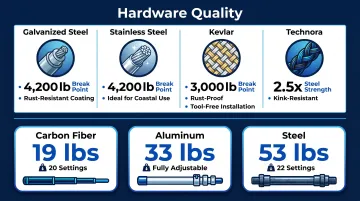
| Cable Material | Break Point | Key Characteristics |
|---|---|---|
| Galvanized steel (plastic-coated) | 4,200 lb (top), 2,000 lb (bottom) | Standard theft-resistant option |
| Stainless steel | 4,200 lb (both cables) | Rust-resistant, recommended for coastal use |
| Kevlar (UV-resistant jacket) | 3,000 lb (both cables) | No sharp points, rust-proof, tool-free installation |
| Technora (aramid fiber) | 2.5x steel strength | Prevents kinking, curling, fraying in high-use indoor environments |
Source: VolleyballUSA.com; Sports Imports
Plain steel cables corrode rapidly outdoors, especially in salt-air coastal environments. Choose galvanized or stainless steel for any outdoor or humid installation. In coastal locations — Florida, California, Hawaii — stainless steel is the right call over galvanized; it holds up against salt air where galvanized coatings eventually fail.
Pole material comparisons:
| Pole Material | Weight | Height Settings | Key Advantage |
|---|---|---|---|
| Carbon fiber | 19 lbs | 20 pin-stop positions | Lightest weight, reduces setup labor |
| Aluminum | 33 lbs | Pin-stop adjustable | Mid-weight, corrosion-resistant |
| Steel | 53 lbs | 22 pin-stop positions | Heaviest, most adjustment options |
Source: Sports Imports
Multi-use facilities serving different age groups benefit from carbon fiber poles that reduce setup labor without sacrificing adjustability. Steel poles offer the most height settings but require more personnel for safe handling.
Tensioning systems. Basic rope tie-offs work for casual backyard use but wear quickly under repeated adjustments. Tournament-grade systems use rope ratchets and four-point slide-lock tensioners. Championship-grade installations specify dedicated winch/ratchet systems that provide smooth, precise, and reliable net tension without stressing the mesh material. Over-tensioning aging nets accelerates failure because weakened molecular structure snaps more easily under load.
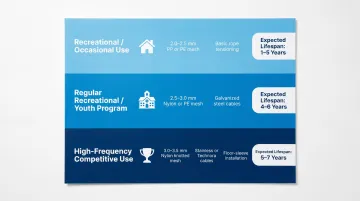
Intended Use and Play Frequency
Durability needs scale with use frequency and intensity. A backyard net used weekly has very different wear demands than one running daily for a school program or club practice.
Use-case framework for buyers:
Recreational/occasional use — Weekly or less frequent play, 1-2 hours per session
- Lighter materials acceptable: 2.0-2.5 mm polypropylene or PE mesh
- Basic rope tensioning adequate
- Portable systems with lighter poles reduce storage burden
- Expected lifespan: 1-3 years for budget models, 3-5 years for mid-grade
Regular recreational or youth program use — 2-4 days per week, multiple hours per session
- Mid-grade nylon or PE netting with 2.5-3.0 mm thread gauge
- Adjustable height systems to serve different age groups
- Galvanized steel cables and powder-coated aluminum poles
- Expected lifespan: 4-6 years with proper maintenance
High-frequency competitive use — Daily practice and matches, 4-8 hours per day
- Heavy-duty construction: 3.0-3.5 mm nylon mesh, knotted for maximum strength
- FIVB or NFHS-compliant specifications
- Commercial-grade hardware: stainless steel or Technora cables, dedicated ratchet tensioning systems
- Floor-sleeve permanent installation with solid brass anchors
- Expected lifespan: 5-7 years for netting (with mesh replacement 2-3 times during the post system's 8-12 year lifecycle)
Indoor vs. Outdoor Environment Considerations
Indoor nets are designed for consistent temperature and humidity. They prioritize tension consistency and regulation height precision, but are not built to withstand UV, rain, or wind. Using an indoor net outdoors accelerates degradation rapidly.
What makes outdoor nets structurally different:
- UV-stabilized mesh — Fiber-integrated protection prevents brittleness and discoloration outdoors
- Rust-resistant hardware — Galvanized or stainless steel cables with plastic coatings
- 18-22 oz reinforced vinyl side tapes instead of canvas bands — vinyl sheds moisture; canvas absorbs it
- Weighted bottom cables — Keep the net from lifting in wind
- Kevlar bottom ropes — Beach nets use Kevlar specifically to resist sand abrasion
Indoor nets use canvas bands that absorb moisture and promote mildew. Untreated nylon mesh and uncoated steel cables will corrode and degrade when exposed to continuous outdoor conditions. The NFHS 2026-27 Points of Emphasis identifies nets that have been "taped or improvised to keep them working" as strong replacement candidates — a common outcome when indoor-rated equipment is forced into outdoor service.
Net Size, Height Compliance, and Adjustability
Standard net dimensions are defined by governing bodies but remain consistent across FIVB, USAV, and NFHS standards:
- Net width (depth): 1 m (+/- 3 cm)
- Net length: 9.50 to 10 m (31'6" to 33'), with 25-50 cm extensions beyond side bands
- Mesh size: 10 cm (4 in.) square
- Height tolerance: Must not exceed official height by more than 2 cm at center court
Regulation net heights by division:
| Division | Gender | Height (Metric) | Height (Imperial) |
|---|---|---|---|
| Adult/Senior (FIVB/USAV/NFHS) | Men | 2.43 m | 7' 11 5/8" |
| Adult/Senior (FIVB/USAV/NFHS) | Women | 2.24 m | 7' 4 1/8" |
| 15-18 & Under (USAV) | Boys | 2.43 m | 7' 11 5/8" |
| 15-18 & Under (USAV) | Girls | 2.24 m | 7' 4 1/8" |
| 13-14 & Under (USAV) | Boys/Girls | 2.24 m | 7' 4 1/8" |
| 11-12 & Under (USAV) | Boys/Girls | 2.13 m | 7' 0" |
| 10 & Under (USAV) | Boys/Girls | 1.98 m | 6' 6" |
Source: FIVB Official Volleyball Rules 2025-2028; Sports Imports
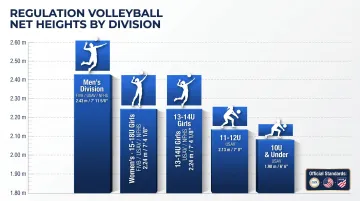
Buying a regulation-size net matters even for recreational use. Undersized nets lead to bad habits in competitive players and don't fit standard court setups, creating compatibility problems when upgrading facilities.
Adjustable-height systems. Facilities serving multiple age groups or sports benefit from adjustable systems. Pin-stop mechanisms provide repeatable height precision without mechanical wear. The strongest carbon fiber poles on the market offer 20 different net height settings suitable for men's, women's, and youth play, weighing just 19 lbs for easy repositioning. Steel poles offer 22 settings but weigh 53 lbs, requiring multiple people for safe handling. Cheaper adjustment hardware (particularly non-ratcheting systems) wears out faster under repeated use.
How The Windscreen Factory Can Help
The Windscreen Factory has supplied durable netting, windscreens, and facility equipment to schools, parks, athletic complexes, and event venues nationwide since 2014. Their netting meets CPSIA certification standards with lead levels far below 100 ppm — a critical requirement for school and youth athletic programs that must comply with safety regulations.
The Windscreen Factory provides customizable netting solutions tailored to specific court dimensions, use environments, and facility branding needs. Their products are built with weather-resistant, mildew-resistant materials engineered to perform across all conditions, cutting down on costly replacement cycles.
Key differentiators:
- Custom branding on nets, padding, and surrounding equipment — logos, colors, and facility identity built in from the start
- Photoshop renderings let buyers see the finished setup before placing an order
- Weather- and mildew-resistant materials built for outdoor use, not repurposed from indoor designs
- Serves schools, HOAs, parks departments, and sports complexes across the United States
- Installation support covers post setting, cable hardware, and proper tensioning for safe, lasting performance
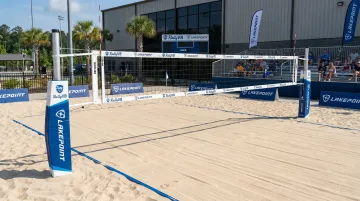
Facilities evaluating volleyball net systems can reach The Windscreen Factory at 888.619.2228 or sales@thewindscreenfactory.com to discuss court dimensions, material specifications, and configuration options before committing to an order.
Conclusion
Picking a durable volleyball net means aligning material quality, hardware construction, and net type with the actual environment and intensity of use. Buyers who take the time to evaluate these factors — UV-stabilized mesh with HALS protection, galvanized or stainless steel cables, pole materials matched to portability needs, and adjustment systems designed for repeated use — avoid the hidden cost of frequent replacements.
Durability is not a one-time purchase decision. Proactive maintenance extends the life of even a well-chosen net, so build a simple inspection habit into your seasonal routine:
- Check mesh for fraying edges or early signs of UV degradation
- Inspect cables for rust, kinking, or wear at tension points
- Test hardware — buckles, sleeves, and adjustment mechanisms — for looseness or corrosion
Catching small problems early prevents mid-season failures and pushes out your replacement timeline by years, not months.
Frequently Asked Questions
How do I choose a volleyball net?
Match three factors — environment (indoor vs. outdoor), use frequency, and materials — rather than focusing on price alone. Outdoor nets need UV-stabilized mesh and rust-resistant hardware; high-frequency use demands heavier thread gauge and commercial-grade tensioning systems.
What is the best material for a durable outdoor volleyball net?
UV-stabilized polyethylene (PE) and heavy-gauge nylon are the top choices — PE lasts 4-6 years in harsh weather, while nylon offers better flexibility and abrasion resistance with a 5-7 year lifespan when UV-treated. Both outperform polypropylene, which degrades in 3-5 years and fails rapidly without UV stabilization.
What are the standard dimensions of a volleyball net?
Regulation nets measure 1 m wide (depth), 9.50-10 m long (31'6"-33'), with 10 cm (4 in.) square mesh. Net heights are 2.43 m (7' 11 5/8") for men and 2.24 m (7' 4 1/8") for women per FIVB/USAV/NFHS standards. Youth divisions range from 1.98 m (6' 6") for 10 & Under to 2.13 m (7' 0") for 11-12 & Under.
How long does a quality volleyball net last?
A quality outdoor net with UV resistance and proper hardware lasts 5-7 years; budget recreational nets often need replacement within 1-2 seasons. Storing the net when not in use, checking hardware annually, and patching tears immediately can add years to either.
What is the difference between an indoor and outdoor volleyball net?
Indoor nets prioritize height precision and tension consistency in controlled environments, using canvas bands and untreated mesh. Outdoor nets are built with UV-stabilized mesh, rust-resistant galvanized or stainless steel cables, and reinforced vinyl edges to handle weather and wind loads. Indoor nets degrade rapidly outdoors due to moisture absorption in canvas bands, UV damage to untreated fibers, and cable corrosion.
Can I leave my volleyball net outside all year?
Yes, but it will shorten lifespan even on the most durable nets — UV radiation, moisture cycling, and wind stress degrade materials continuously. Seasonal storage or a weatherproof cover extends net life by 2-3 years, and annual inspections help catch fraying and hardware corrosion before failure.